
Hydraulic Hose Assemblies & JIC Fittings
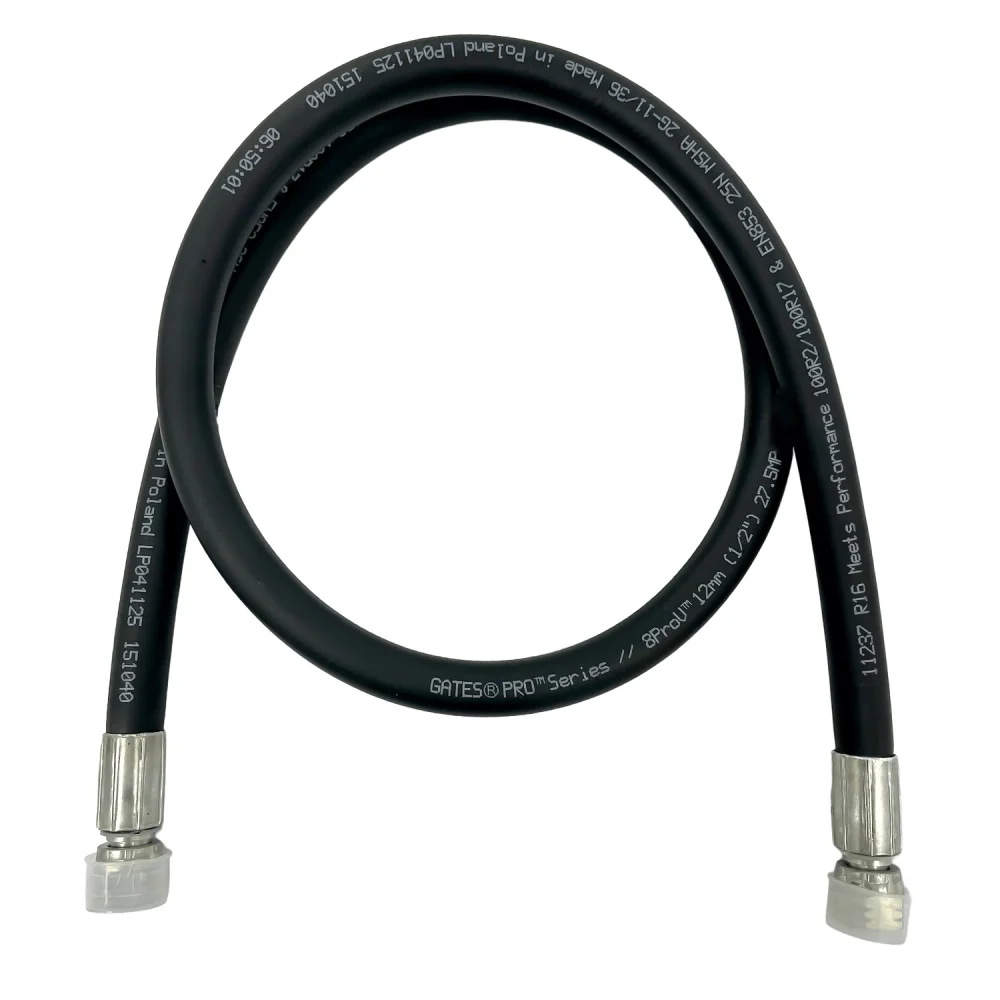
1/2 in × 48 in JIC Hydraulic Hose — HHA-D08-08-FJS-48
3500 PSI complete hose assembly; 1/2 in × 48 in, JIC female swivel ends and 3.5 in minimum bend radius.
1/2 in × 48 in · 3500 PSI
PRODUCT CATEGORY
Compare 1/2 in × 48 in and 3/4 in × 72 in JIC hose assemblies by length, working pressure and ends.
| Product | Inside diameter | Length | Working pressure | Ends |
|---|---|---|---|---|
| HHA-D08-08-FJS-48 | 1/2 in | 48 in | 3500 PSI | Straight JIC female swivel |
| FA-UFWTF12-JIC-72 | 3/4 in | 72 in | 4350 PSI | 1-1/16-12 JIC female |
2 products
3500 PSI complete hose assembly; 1/2 in × 48 in, JIC female swivel ends and 3.5 in minimum bend radius.
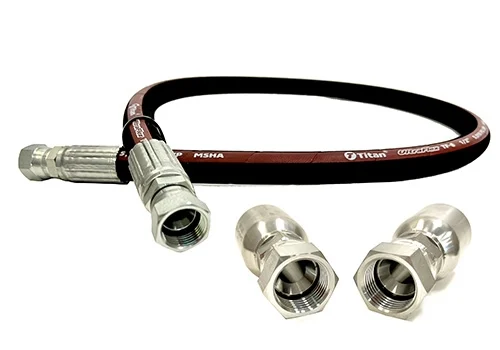
4350 PSI assembly with 1-1/16-12 JIC female connections and 37° sealing faces.
Send the part number or describe the equipment you need.
Send a sourcing requestDiameter and length describe the hose body; thread, sealing face, angle and swivel arrangement describe each end. Label the ends A and B on a sketch, with the length measurement endpoints.
Add working pressure, available bend space and protective sleeve requirements. When angled ends are used, include their relative orientation in the drawing.
HHA-D08-08-FJS-48 is a 3,500 PSI completed assembly with a 4,000 PSI hose body. FA-UFWTF12-JIC-72 is a 4,350 PSI assembly. Compare the completed rating alongside the actual end connections, bore and route.
Both catalog configurations use two-wire steel-braid construction and a −40°C to +100°C operating range. The smaller hose has an 88.9 mm minimum bend-radius specification; the finished route also needs room for the fitting exits and any movement.
The finished assembly includes the selected hose body and its crimped ends. The JIC nut’s thread and37-degree sealing seat are separate connection fields; elbow clocking describes the route between the two ends.
| Assembly | Bore / length | Ends | Finished rating |
|---|---|---|---|
| HHA-D08-08-FJS-48 | ½ in / 48 in | Straight JIC female swivel ends | 3, 500 PSI |
| FA-UFWTF12-JIC-72 | ¾ in / 72 in | JIC female, 1-1/16-12 thread, 37° seat | 4, 350 PSI |
Excavator hydraulic hoses fall into a few groups, each with a different pressure, movement and wear pattern. Knowing which group a hose belongs to tells you which construction and ends to look for.
| Hose group | Pressure level | Movement and wear risk |
|---|---|---|
| Boom, arm and bucket cylinder lines | Main system pressure | Flex at every pivot; rub where they cross |
| Attachment auxiliary lines | Main or auxiliary relief pressure, often with impulse | Repeated connection and disconnection; high flex at the arm tip |
| Pump delivery lines | Main system pressure | Little movement but heat and vibration |
| Return and case-drain lines | Low pressure | Blockage or restriction causes damage elsewhere |
| Pilot and control hoses | Low to moderate pressure | Small bore; easy to kink and chafe in the cab area |
| Pump suction hose | Below atmospheric | Must not collapse; a soft hose lets the pump cavitate |
The two assemblies listed here are attachment-style lines with JIC female ends: a 1/2 in bore at 48 in and a 3/4 in bore at 72 in. They suit jobs where the circuit pressure, bore and ends match their published ratings.
The reinforcement layer decides how much pressure and impulse a hose can take and how flexible it is. Two-wire steel braid, used on both listed assemblies, is the common middle ground for medium-pressure attachment and cylinder lines.
| Construction | Typical use | Trade-off |
|---|---|---|
| One-wire braid | Lower-pressure lines, some return lines | Flexible but lower pressure rating |
| Two-wire braid | General cylinder and attachment lines | Balanced pressure rating and flexibility |
| Four- or six-wire spiral | High-pressure, high-impulse lines such as breaker circuits on larger machines | Higher rating but stiffer, with a larger bend radius |
| Thermoplastic | Pilot and control lines | Light and smooth but needs protection from heat |
| Suction hose with helix | Pump inlet | Resists collapse; large bore |
A stronger hose is not always a better choice. Spiral hose needs more room to bend and pulls harder on fittings, which can be a problem on a tight arm route. Match the construction to the circuit’s pressure and the space available.
A JIC hose rarely screws straight into a machine port. Most installations include an adapter between the hose end and the port, and attachment circuits usually add a quick coupler pair at the arm.
The hose specification guide explains how to tell JIC, SAE 45°, ORFS and BSP ends apart by thread and seat.
A hose failure stops a powered attachment until a replacement arrives. A small kit of the attachment’s hoses kept with the machine turns a long stoppage into a short repair.
For a hydraulic breaker, the supply and return pair belong in the kit. Rotating grapples and tiltrotators add rotation and control hoses, which are usually smaller bore and easy to overlook.
| Finding | What it usually means | Action |
|---|---|---|
| Cracked or crazed cover | Age, heat or ozone damage | Plan replacement |
| Exposed wire braid | Abrasion through the cover | Replace and fit a sleeve or guard |
| Blister or bulge | Inner tube or reinforcement failure | Replace before further use |
| Wet fitting shell | Leak at the crimp or seal | Replace the assembly; do not re-crimp |
| Kink near a fitting | Hose too short or badly routed | Replace with corrected length or angled end |
| Stiff, hard hose | Overheating | Replace and check oil temperature |
Never check for leaks by feeling along a hose. A fine jet of oil under pressure can penetrate skin and needs urgent medical attention. Use cardboard and follow the machine manual’s procedure.
Start from the circuit, not the hose. The 1/2 in × 48 in assembly has a 3,500 PSI rating and straight JIC female swivel ends; the 3/4 in × 72 in assembly has a 4,350 PSI rating and 1-1/16-12 JIC female ends. Choose the bore that carries your circuit’s flow, the length that fits the route without stretching or kinking, and a rating at or above the relief setting.
Only if the assembly working pressure is at or above the auxiliary relief setting and the breaker maker accepts a two-wire braid hose for that circuit. Some breakers, especially on larger machines, call for a higher-impulse construction. Check the breaker manual and the machine relief setting before ordering.
Both listed configurations state a −40°C to +100°C operating range. Hydraulic oil that regularly runs near the top of that range will shorten hose life, so check the cooler and oil temperature if hoses on a machine are hardening early.
It is safe on pressure, but check the rest. Higher-rated hoses can be stiffer, with a larger bend radius and a larger outside diameter. Make sure the bore, ends, length and route still suit, and that adapters and couplers in the line share the rating.
Yes, through an adapter with a JIC male on one side and the correct BSP male with its seal on the other. Never force a JIC nut onto a BSP thread; the threads and seals are different. Identify the port thread first and order the adapter on the same list.
For supply and return lines that have seen the same service, replacing both is sensible, because the second hose is usually close to failure. For lines of different ages or duties, inspect each and replace on condition. Record the date so the next inspection has a reference.
Send your machine model, required quantity and destination. Add installation items, wear parts and service quantities to the same inquiry.