
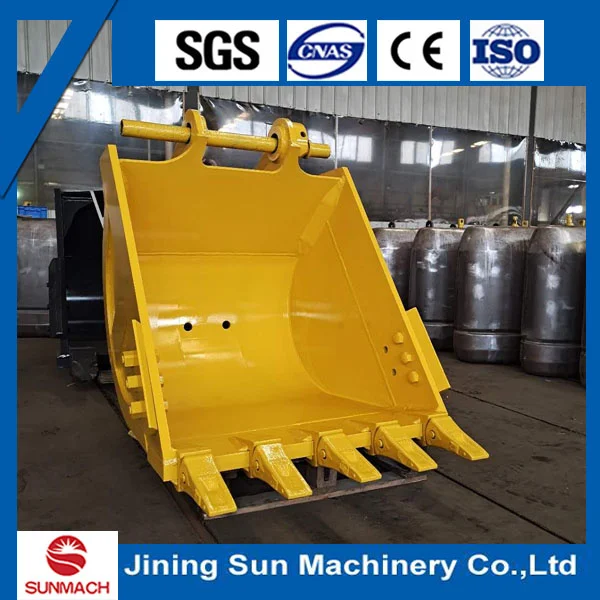
Excavator Rock Buckets & Hydraulic Tilt Buckets
PC200 0.8 m³ Heavy-Duty Rock Bucket
0.8 m³ toothed rock bucket for Komatsu PC200 excavation and abrasive material handling.
0.8 m³ rock bucket
PRODUCT CATEGORY
PC200 0.8 m³ rock bucket and TB50 1200 mm tilt bucket: compare excavation and slope-finishing configurations.
| Product | Machine | Capacity | Working feature |
|---|---|---|---|
| PC200-0.8m3 | Komatsu PC200 | 0.8 m³ | Toothed rock bucket |
| TB50 | 5 t excavator | 0.3 m³ | 1200 mm width · ±45° tilt |
2 products
0.8 m³ toothed rock bucket for Komatsu PC200 excavation and abrasive material handling.
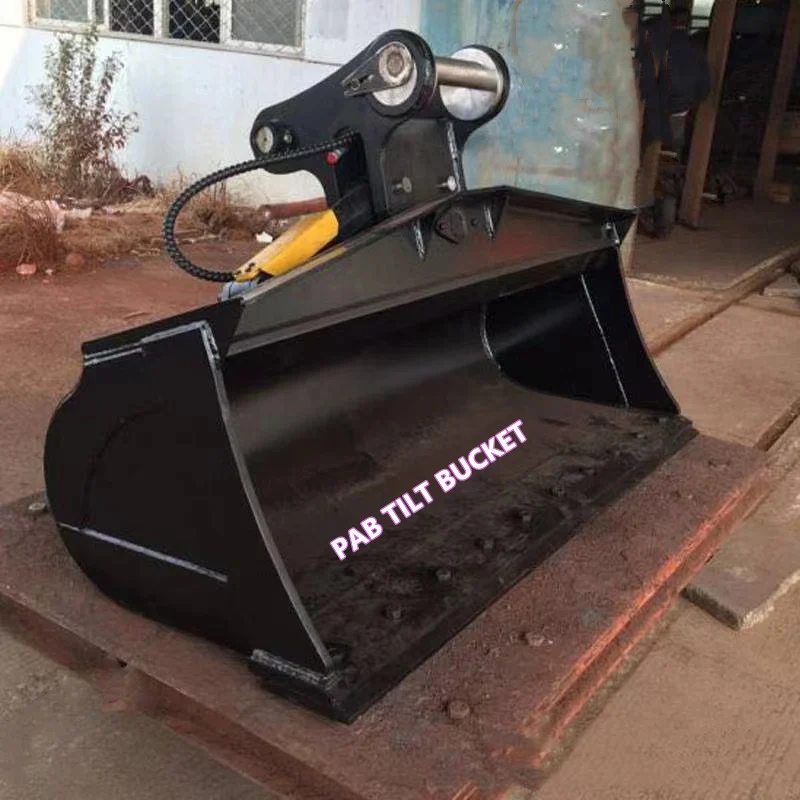
1200 mm wide, 0.3 m³, 45 mm pins and 45° tilt to each side for slope finishing.
Send the part number or describe the equipment you need.
Send a sourcing requestBucket breakout force describes the digging force generated through the linkage. A wider cutting edge spreads that force across more material, while a toothed rock bucket concentrates penetration at the teeth. Capacity determines volume per fill; material density determines the lifted mass. Choose width, capacity and wear protection together.
List the cutting edge or tooth system, side cutters and wear plates. For the TB50, add tilt hoses and cylinder service items. For the PC200 bucket, link the spare teeth to the selected adapter system.
The PC200 0.8 m³ rock bucket carries a toothed digging face and a selected wear-steel package. TB50 puts a 1,200 mm smooth finishing edge on a 5 tonne excavator, with two cylinders providing 45° tilt each way. Use the rock bucket to penetrate and load; use the tilt bucket to shape a bank, drainage fall or finished level.
| Purchase task | Body / edge | Installation / wear items |
|---|---|---|
| PC200 broken-rock loading | 0.8 m³ body; chosen width; adapters and teeth | Machine mounting, side cutters, heel strips and spare retaining sets |
| 5 tonne slope or ditch finishing | TB50; 1,200 mm; 0.3 m³; smooth edge | 45 mm pins / 245 mm centres / 170 mm gap; two-way tilt circuit |
| Fleet replacement bucket | Existing tooth or smooth-edge arrangement | Reuse the recorded pin geometry and selected tooth system |
A material name alone leaves the cutting edge, shell and external protection unresolved. On the PC200 order, separate the Q345 structural body from the NM400 or Hardox 400 wear selections. Record thickness and placement for the bottom, side protection, heel strips and cutting edge; pair every adapter with its tooth and retaining system.
Most excavators need more than one bucket over their working life. The shape, edge and steel of each type are tuned for a task, and using the wrong one costs fuel, cycle time and wear.
| Bucket type | Edge and build | Best suited to |
|---|---|---|
| General purpose (digging) | Teeth on a standard lip; medium plate | Soil, clay, sand and mixed ground |
| Heavy-duty | Thicker lip and side plates, extra wear strips | Compacted ground with some stone |
| Rock bucket | Reinforced shell, abrasion-resistant wear steel, rock teeth, often a pointed lip | Broken rock, blasted material, abrasive gravel |
| Ditching or grading | Wide, shallow, smooth edge | Trimming banks, cleaning ditches, final levels |
| Hydraulic tilt bucket | Ditching profile on a tilting frame with cylinders | Slopes, crossfalls and drainage profiles without moving the machine |
| Trenching | Narrow body with teeth | Service and drainage trenches |
| Skeleton (riddle) | Open grid of bars instead of a solid shell | Sorting stone, roots or rubble from soil |
| Clamshell | Two hydraulically closed shells | Vertical digging, shafts, loading loose material |
This range currently lists two contrasting types: the PC200 0.8 m³ heavy-duty rock bucket for digging and loading in rock, and the TB50 1200 mm hydraulic tilt bucket for finishing work on a 5 tonne machine.
An excavator rock bucket is built to survive impact and abrasion rather than to carry the most volume. Several features usually set it apart from a general-purpose bucket of the same capacity.
That weight is the trade-off. A rock bucket on loose, easy material loads more slowly than a general-purpose bucket and uses more fuel. Rock teeth for an excavator bucket are chosen for the same reason: they resist impact but penetrate soft ground less freely. Use a rock bucket where the material really needs it, and switch buckets when the job changes.
Mini excavator rock buckets and rock buckets for backhoes follow the same logic at a smaller scale; on light machines the extra bucket weight is a larger share of the lifting capacity, so check it against the lift chart.
Capacity is a volume. The excavator has to lift mass, so the useful check is capacity multiplied by the density of the material, plus the empty bucket and any coupler.
| Material | Approximate loose density | Mass in a 0.8 m³ bucket |
|---|---|---|
| Dry topsoil | 1.2–1.4 t/m³ | About 1.0–1.1 t |
| Dry sand and gravel | 1.5–1.7 t/m³ | About 1.2–1.4 t |
| Wet clay | 1.7–2.0 t/m³ | About 1.4–1.6 t |
| Broken or blasted rock | 1.5–1.8 t/m³ | About 1.2–1.4 t |
Heaped fill, wet conditions and the bucket’s own weight all push the figure higher. A bucket that is too large for the material slows the arm, increases fuel use and can make the machine light at the rear when working over the side. When choosing between widths or capacities for one machine, choose the smaller bucket for denser material.
A hydraulic tilt bucket puts the profile of a ditching bucket on a frame that rotates side to side. Two cylinders tilt the bucket, so the operator can trim a bank, set a crossfall or clean a V-ditch with the excavator sitting level. The TB50 tilts 45° each way for a 90° total range.
Where a site needs tilt, rotation and quick tool changes together, a tiltrotator is the step beyond a tilt bucket. The tiltrotator overview explains interfaces and control requirements. Hydraulic buckets of any kind add hoses and cylinders to the maintenance list, so include seal kits and spare hoses on the first order.
A skeleton bucket for an excavator replaces the solid back and floor with a grid of bars. Fine soil falls through as the bucket is shaken; stone, roots and rubble stay inside. It is a quick way to clear a building plot of stones or sort demolition rubble, and mini excavator skeleton buckets are common on landscaping jobs.
For larger volumes or a defined product size, a hydraulic screening bucket with a rotating drum gives a more consistent result, and a crusher bucket reduces oversize rock rather than rejecting it. The rotary screening buckets are matched by excavator class from 3.5 to 23 tonnes.
A clamshell excavator bucket has two shells that close hydraulically. It digs straight down, so it suits shafts, pits beside structures and loading from stockpiles or barges where a normal bucket cannot reach. Most hydraulic clamshell buckets also have a rotator and need a second auxiliary function for it.
An orange peel grab bucket has several curved tines instead of two shells, which holds rock, scrap and irregular material better. Both tools hang from the dipper rather than curling with the bucket linkage, so they cannot dig with breakout force in the way a bucket does.
For a machine that mostly digs but sometimes needs to pick and place, a thumb working against the bucket is often the more practical choice. Stick-mount thumbs, main-pin thumbs and complete thumb buckets are compared on the excavator thumbs page.
Every bucket has to match the excavator’s dipper and linkage, or the hitch that sits between them. Four measurements define a pin-on bucket: the two pin diameters, the distance between pin centres and the inside width between the ears. The TB50, for example, uses 45 mm pins, 245 mm centres and a 170 mm ear gap.
The bucket pin measuring guide shows where each dimension is taken and how to record it.
A bucket rarely fails all at once. Checking the same wear points at regular intervals shows when to fit new wear parts and when the shell itself needs repair, which is far cheaper to plan than an emergency rebuild.
| Area | What to look for | Typical action |
|---|---|---|
| Teeth and adapters | Blunt or missing teeth, adapters that let a new tooth rock | Change teeth; plan adapter replacement |
| Lip and edge blade | Thinning, scalloping between teeth, cracks at the corners | Fit lip shrouds or a new edge before the lip wears through |
| Heel and bottom | Wear strips worn flush, plate thinning behind the lip | Replace wear strips; add wear plate where the bucket drags |
| Side walls and cutters | Worn side cutters, side plates thinning at the leading edge | Replace side cutters; build up or plate the sides |
| Mounting ears and bosses | Elongated pin bores, cracked welds around the bosses | Line-bore and bush, or repair welds |
| Pins and bushes | Play at the dipper and link pins | Replace pins and bushes as a set |
On hydraulic buckets, add the tilt or clamshell cylinders, their seals and the hoses to the list. Record the findings against the bucket’s serial or fleet number so wear rates can be compared between jobs.
A heavy-duty bucket strengthens a general-purpose design with thicker plate and extra wear strips. A rock bucket goes further: abrasion-resistant steel over the bottom, heel and sides, a reinforced and often pointed lip, rock teeth and side protection. The rock bucket survives impact and abrasion better but is heavier and loads loose material more slowly.
It depends on the material and the machine’s configuration. This range lists a 0.8 m³ rock bucket for the Komatsu PC200, a common 20 tonne class machine. Denser material such as wet clay calls for a smaller bucket than dry topsoil. Check the excavator maker’s bucket chart for the boom and arm fitted, and confirm the mounting dimensions.
It needs a double-acting auxiliary circuit at the dipper to drive both tilt cylinders in each direction. Proportional control helps when trimming to a line. Check the circuit’s flow and relief setting against the bucket maker’s requirements, and route the hoses so they follow full curl and tilt without strain.
A skeleton bucket sorts material. Its open grid lets fine soil fall through while keeping stones, roots and rubble, so it is used for clearing stones from plots, sorting demolition rubble and handling rock without carrying fines. It is less effective in wet clay, which blocks the grid.
They are related but not identical. A clamshell has two solid shells and handles loose material such as soil, gravel and sludge well. A grab can mean a clamshell, a multi-tine orange peel grab for rock and scrap, or a log or demolition grapple. Describe the material and whether rotation is needed when asking for a quote.
Only if its mounting matches the excavator’s pins and ear width, or the coupler it will hang from. Backhoe and excavator buckets of similar size often use different pin sizes and centres. Measure both before assuming a bucket will transfer between machines.
It will dig most ground, but it is a heavier, slower tool in easy material. In loose soil, sand or topsoil, a general-purpose bucket of the same width usually fills more fully and cycles faster. Many operators keep both and change over with a quick coupler as the ground changes.
The term covers any excavator bucket with its own hydraulic cylinders or motor, driven from the auxiliary circuit. Common examples are tilt buckets, clamshell buckets, thumb buckets, crusher buckets and rotary screening buckets. Each needs the right auxiliary circuit, flow and hose routing, and adds cylinders or motors to the service list alongside the usual teeth and edges.
Send your machine model, required quantity and destination. Add installation items, wear parts and service quantities to the same inquiry.