
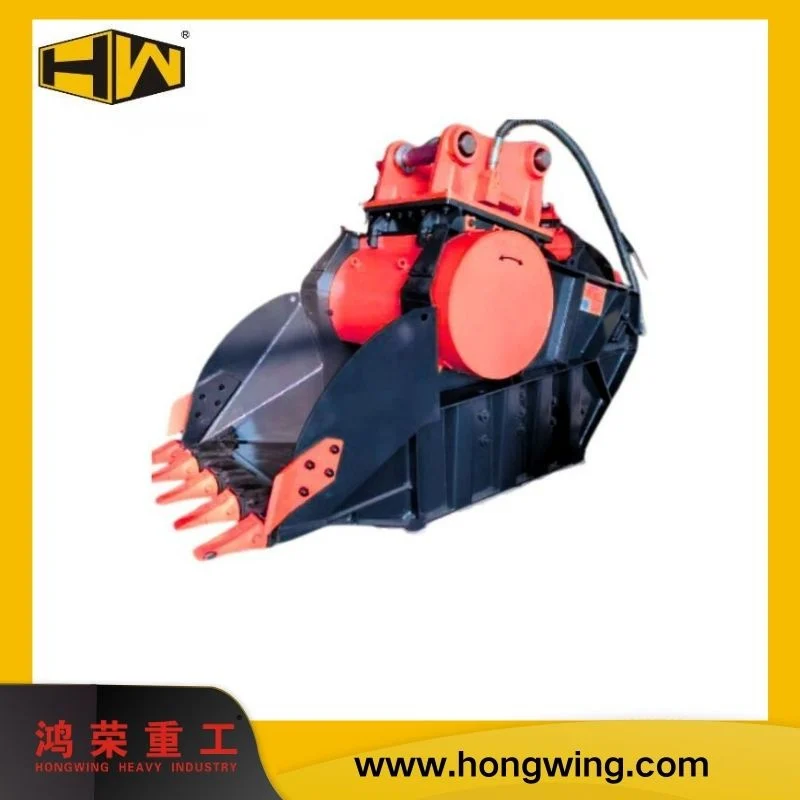
Excavator Crusher Buckets for Rock & Concrete
SCB Crusher Bucket for 15 Tonne Excavators
1394 kg hydraulic jaw-crushing attachment for on-site rock and concrete processing.
15 t carrier · 1394 kg
PRODUCT CATEGORY
Compare SCB 15T and HWPD40 jaw crusher buckets, carrier classes, feed specification and output adjustment.
| Product | Carrier class | Bucket mass | Purchase configuration |
|---|---|---|---|
| SCB-15T | 15 t | 1,394 kg | SCB body, carrier bracket, jaw set and hydraulic package |
| HWPD40 | 30–40 t | 3,500 kg | 900 × 520 mm feed; 12–120 mm discharge adjustment |
2 products
1394 kg hydraulic jaw-crushing attachment for on-site rock and concrete processing.
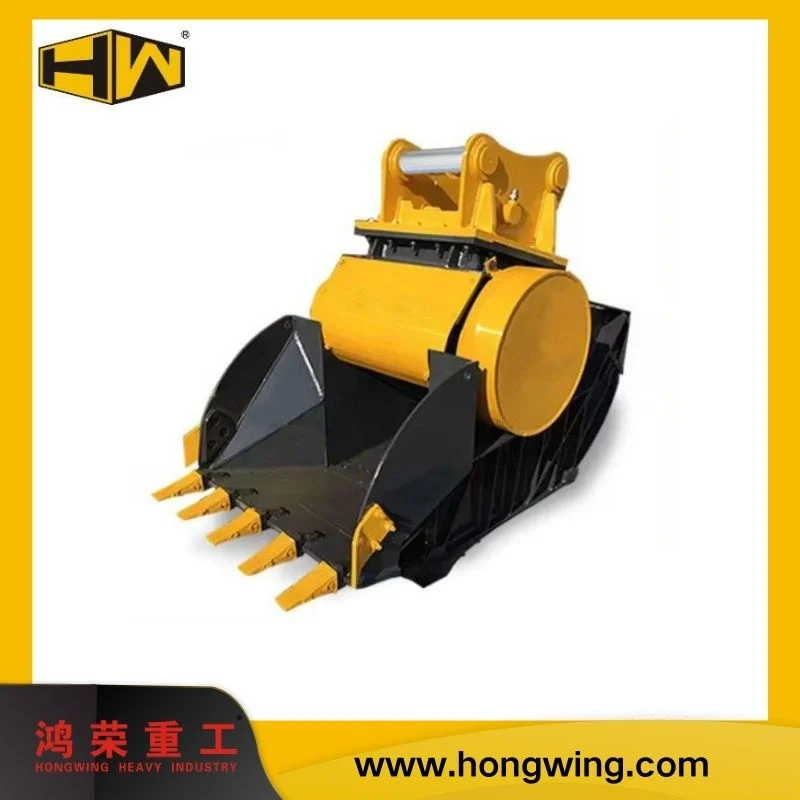
900 × 520 mm feed specification, 12–120 mm discharge adjustment and 3500 kg weight.
Send the part number or describe the equipment you need.
Send a sourcing requestA crusher bucket turns large pieces into smaller aggregate. A screen then separates that aggregate into fractions when needed. A breaker can prepare oversize boulders before jaw crushing.
Name the final use: backfill, sub-base or another aggregate task. Add feed dimensions, material photos, the excavator and the hydraulic circuit. Jaw plates and other wear items belong beside the attachment on the quote.
SCB is the 1,394 kg Hongwing configuration for the 15 tonne class. For an independent hydraulic and feed comparison in that carrier range, MB BF60.1 S4 uses a 610 × 500 mm mouth and a 120–150 L/min circuit on 10–18 tonne excavators. HWPD40 is the larger 3,500 kg Hongwing unit for 30–40 tonne machines with 900 × 520 mm feed and 12–120 mm discharge adjustment. These are separate manufacturer products.
| Parameter | BF60.1 S4 |
|---|---|
| Carrier / bucket mass | 10–18 t / 1,650 kg |
| Loading capacity | 0.55 m³ |
| Crusher mouth | 610 × 500 mm |
| Oil flow | 120–150 L/min |
| Working pressure | 220–280 bar |
| Return pressure | Less than 10 bar |
| Envelope A / B / C | 1,000 / 1,745 / 1,100 mm |
| Stage | Equipment decision | Order output |
|---|---|---|
| Feed preparation | Breaker / handling tool for oversize pieces | Representative maximum feed and prepared pile |
| Jaw reduction | Crusher bucket, excavator mount and motor circuit | Requested discharge setting |
| Grading | Screen opening and two stockpile areas | Passing fraction and retained fraction |
| Wear replenishment | Fixed / moving jaw plates and drive group | Matched jaw set, fasteners and assembly identification |
An excavator crusher bucket is a small jaw crusher built into a bucket shell. Inside the shell are two jaw plates: a fixed jaw bolted to the body and a moving jaw driven through an eccentric shaft by a hydraulic motor on the excavator’s attachment circuit. The operator scoops feed into the open mouth, lifts the bucket and tilts it so the material falls towards the jaws. As the eccentric turns, the moving jaw closes on the fixed jaw, breaks the pieces and lets them drop lower into the narrowing gap. Material leaves through the discharge opening at the bottom once it is small enough to pass.
The size of that discharge opening is the setting the buyer controls. On jaw crusher buckets it is normally changed with spacers or shims behind the jaw, so the output can be set coarser for bulk fill or finer for a sub-base layer. The HWPD40, for example, has a published discharge adjustment of 12–120 mm. The figure describes the jaw gap, not a single-size product: any jaw crusher produces a range of particle sizes below and slightly above the setting, which is why a screening stage follows when a defined grading is required.
A crusher bucket is not a digging bucket. Its mouth, jaws and drive are built for loading loose feed, so it should not be used to break out ground, prise blocks or push piles.
Jaw plates are the main consumable on any jaw crusher bucket. They are bolted in rather than welded, so they can be changed on site when the teeth are worn flat or the plates start to crack. On many designs the plates can be turned end for end once, because wear concentrates in the lower part of the jaw where the final reduction happens. Check the bucket manual before reversing plates; some profiles are handed and only fit one way.
Order the fixed and moving plates as a matched set with their bolts, and keep the plate profile and the bucket model on the order. A photograph of the installed jaws, with a tape measure in shot, makes a repeat order simpler. Hard, abrasive rock such as granite or quartzite wears plates much faster than limestone or clean concrete, so stock spares according to the feed rather than the calendar.
A bucket crusher for excavator use is heavy for its size, because the jaws, eccentric shaft, bearings and flywheel sit inside a reinforced shell. Match the crusher to the carrier by weight class first, then confirm that the machine can hold the bucket and a full load of broken concrete or rock at the working radius. Broken rock in a loose pile typically weighs around 1.5–1.8 tonnes per cubic metre, so the loaded bucket can be much heavier than its empty mass.
| Model | Carrier class | Empty mass | Published feed / discharge | Typical use |
|---|---|---|---|---|
| SCB-15T crusher bucket | 15 t | 1394 kg | Hydraulic jaw crusher; feed and output defined per project | Local recycling of concrete and inert rock on mid-size sites |
| HWPD40 heavy crusher bucket | 30–40 t | 3500 kg | 900 × 520 mm feed; 12–120 mm discharge | Larger rock and concrete volumes on heavy carriers |
The feed size matters as much as the carrier. A piece that will not enter the mouth has to be broken first, and a slab that just fits will bridge across the jaws and slow the cycle. As a rule of thumb, aim for feed pieces comfortably smaller than the mouth opening in both directions. Mini excavator crusher buckets and skid steer crusher buckets exist for very small carriers, but the units on this page are built for 15-tonne and 30–40 tonne excavators.
Crusher buckets are among the most flow-hungry excavator attachments. The motor runs continuously while the jaws work, so the auxiliary circuit has to deliver steady flow at pressure for long periods. The independent comparison model on this page lists 120–150 L/min at 220–280 bar for a 10–18 tonne carrier, and the HWPD40 lists a 25–35 MPa (250–350 bar) working pressure. Ask for the flow figure of the exact crusher before assuming a carrier’s hammer circuit is enough.
A circuit that delivers less than the required flow will still turn the jaws, only more slowly, and output drops sharply. A circuit set above the crusher’s pressure rating risks motor and bearing damage. Set both with a flow and pressure test rather than by feel.
A concrete crusher bucket turns demolition rubble into aggregate that can go back into the same project as fill, a working platform or a haul road. The quality of that product depends on what goes in. Clean concrete and brick crush well. Timber, plastic, gypsum and soil reduce the value of the output and should be picked out before crushing.
Reinforcing bar is the usual problem. Short ends of rebar pass through the jaws with the crushed material, but long bars and mesh can wrap around the jaw or hang out of the discharge. Cut and separate steel first. A concrete pulverizer strips most of the rebar from slabs and walls and reduces large pieces at the same time, so the crusher bucket receives smaller, cleaner feed. Oversize blocks that will not enter the mouth can be broken with a hydraulic breaker before they reach the crusher.
| Feed problem | Effect in the crusher | Preparation |
|---|---|---|
| Long rebar and mesh | Wraps the jaw, blocks discharge | Pulverize and remove steel; cut long bars |
| Slabs larger than the mouth | Bridges across the jaws | Break down with a breaker or pulverizer |
| Soil and fines in the feed | Packs the jaws, wastes capacity | Screen fines out before crushing |
| Timber, plastic, insulation | Contaminates the aggregate | Hand-pick or sort with a grapple |
A rock crusher bucket for excavator work handles blasted or ripped rock, cobbles from excavation, and stone recovered from trenching. Rock type sets the wear rate and the output. Softer sedimentary rock crushes quickly with modest jaw wear; hard igneous rock and quartz-rich stone crush more slowly and wear plates faster. Wet clay mixed with the feed is often a bigger problem than hardness, because it sticks in the crushing chamber and slows discharge.
For stony ground where most of the material is already small enough to reuse, screening alone can be the cheaper route. A rotary screening bucket separates the reusable fraction, and only the retained stone goes to the crusher. That reduces crusher hours and jaw wear on the same job.
Crusher bucket output is set by the feed, the discharge setting and the operator, so published hourly figures are only a guide. A finer setting gives a smaller product but fewer tonnes per hour. A coarse setting with clean, prepared feed gives the highest rate. Plan the site so the excavator can load, crush and discharge without tracking.
Dust control is part of the plan. A water spray at the discharge keeps dust down near workers and neighbours, and many sites require it. Noise from crushing is lower than from breaking, but hearing protection is still needed near the bucket.
| Item | What to check | Why it matters |
|---|---|---|
| Bearings and eccentric shaft | Grease at the interval in the manual; listen for noise | Bearing failure is the most costly drive repair |
| Jaw plate bolts | Tightness at the start of each shift | Loose plates crack and damage their seats |
| Jaw gap and spacers | Setting matches the required product | Wear opens the gap and coarsens output |
| Hydraulic motor and hoses | Leaks, chafing, fitting tightness | Oil loss and contamination of the carrier system |
| Shell and mouth | Cracks at welds and wear on the lip | Early repair avoids structural damage |
| Mounting pins and bracket | Pin wear, bush play, cracks | A crusher is heavy and works under vibration |
Keep the carrier’s hydraulic oil and filters on schedule. A crusher motor running at high flow for long periods circulates a lot of oil through the attachment, so contamination from a leaking fitting or a dirty coupler reaches the main system quickly. Cap couplers when the crusher is removed.
A crusher bucket is an excavator attachment that combines a bucket shell with a jaw crusher. The excavator loads rock or concrete into the mouth, and a hydraulic motor drives a moving jaw against a fixed jaw to reduce the pieces. Crushed material drops out through an adjustable discharge opening. It lets contractors make reusable aggregate on site instead of hauling rubble away and buying fill.
Yes, but steel should be separated first. Short pieces of reinforcement usually pass through with the crushed material, while long bars and mesh can wrap around the jaw or block the discharge. Pulverizing slabs and walls before crushing strips most of the rebar and reduces piece size, which also improves crusher output and lowers jaw wear.
The excavator must match the bucket’s carrier class and have enough auxiliary flow and a low-pressure return line. In this range the SCB-15T suits 15-tonne excavators and weighs 1394 kg, while the HWPD40 suits 30–40 tonne machines and weighs 3500 kg. Check the lift chart with the bucket full of broken material at your working radius.
Jaw crusher buckets usually change the discharge opening with spacers or shims behind the jaw. A smaller opening gives finer material and lower output; a larger one gives coarser material at a higher rate. Follow the manufacturer’s procedure, isolate the hydraulics before working near the jaws, and re-check the setting as the plates wear.
The jaw plates are bolted replaceable parts, so a worn set is changed without replacing the bucket. On many designs the plates can be reversed once to use the less worn end. Plates are specific to the crusher model and profile, so order the fixed and moving jaws as a matched set with their bolts and quote the bucket model.
If most of the material is already small enough to reuse and you only need stones removed, a screening bucket is usually the better first step. If the stones themselves must be reduced to aggregate, you need a crusher bucket. Many recycling jobs use both: screen first to remove soil and fines, then crush the retained stone.
The common causes are low auxiliary flow, high return-line pressure, worn jaw plates, feed that is too large or contains clay and fines, and overfilling the bucket. Test the circuit flow and pressure, inspect the jaws, prepare the feed and run the bucket at a fill level the jaws can take. Output also falls as the discharge setting is made finer.
Send your machine model, required quantity and destination. Add installation items, wear parts and service quantities to the same inquiry.