Choose the operation from the material problem
If the pieces are too large, the job needs size reduction. If useful fine material is mixed with larger particles, it needs separation. A jaw crusher breaks material between jaws; a rotary screen passes smaller particles through its mesh.
| Task | Tool | Purchase specification |
|---|---|---|
| Reduce rock or concrete | Crusher bucket | Feed size and target aggregate |
| Separate soil and stone | Screening bucket | Screen opening and retained fraction |
| Reduce, then grade | Crusher + screen | Output setting plus screen sizes |
Match the processing setup to the carrier
SCB 15T weighs 1,394 kg and serves the 15 tonne class. HWPD40 serves 30–40 tonne excavators and weighs 3,500 kg. The three PAB screeners serve 3.5–5.5, 12–17 and 18–23 tonne classes. Separate machine selection from the target grading.
Add upstream and downstream work
A breaker can prepare oversize boulders for the crusher. A loader can stockpile processed aggregate. A second screening stage can separate fractions after crushing. Each step affects handling space and the equipment order.
A pulverizer or shear performs another stage
A pulverizer works concrete between its jaws and can separate reinforcing steel during secondary demolition processing. A shear’s selected jaw set carries out its cutting or demolition task. These operations differ from feeding a jaw-crusher bucket or grading material through a screen.
Put the material form and the required operation on the purchase list: large concrete sections, reinforcing steel, a steel profile to cut, or aggregate that needs a target size. Then select the jaw / tool package, carrier and hydraulic circuit for that operation.
Write the material order before the attachment order
Include the source material, largest pieces, wanted final fraction and intended use. For soil, add moisture, clay and root content to the description. For crusher buckets, put spare jaw plates on the order; for screens, put the selected openings and replacement panels on the order.
How a jaw crusher bucket reduces rock and concrete
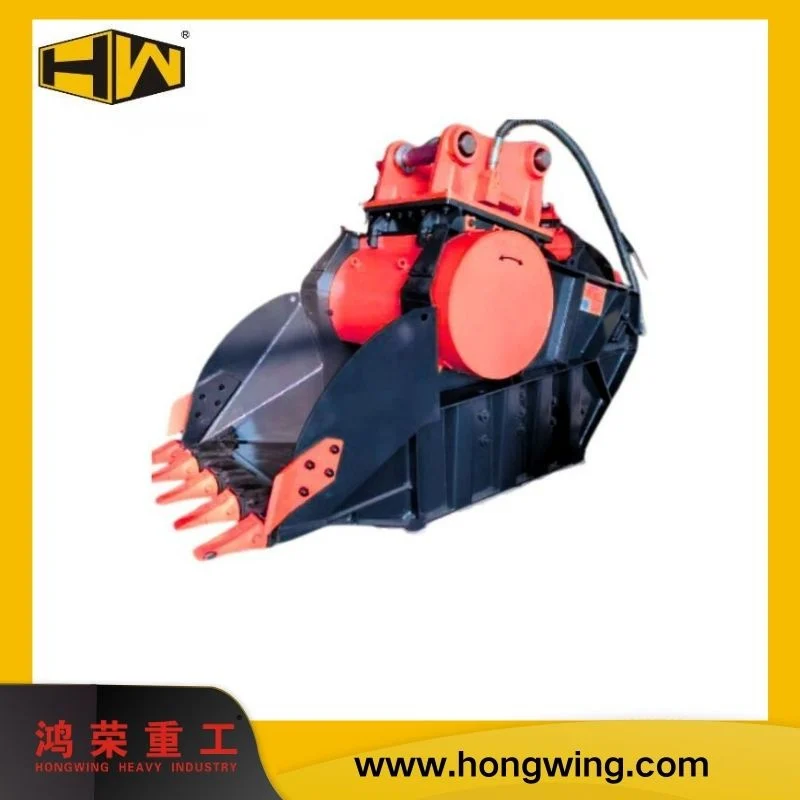
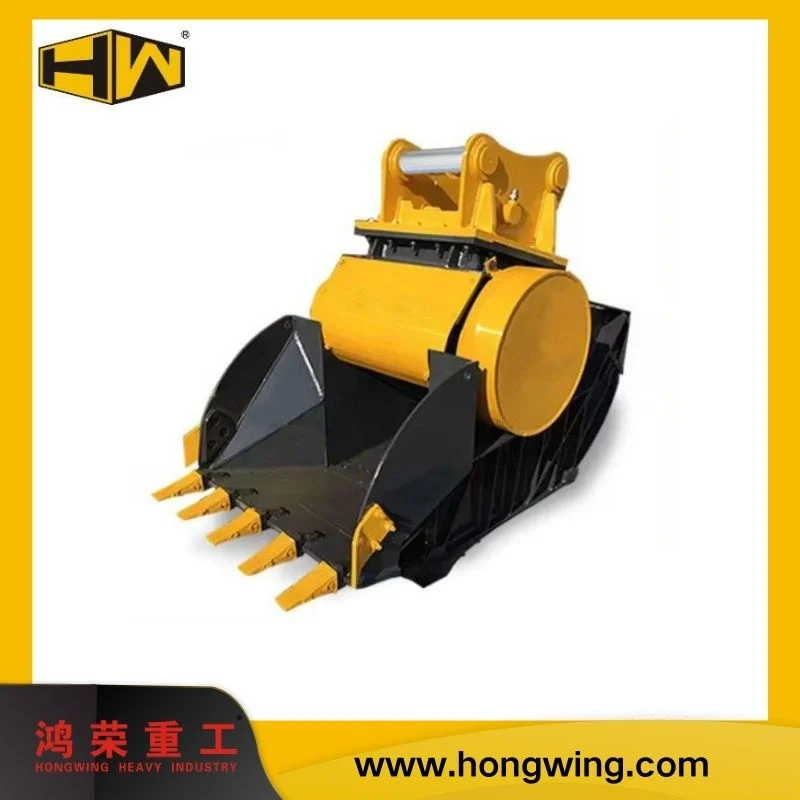
A crusher bucket is a small jaw crusher built into a bucket shell. The operator scoops material into the open mouth and curls the bucket so the load falls toward the jaws. A hydraulic motor drives an eccentric shaft that moves one jaw against a fixed jaw, and each stroke breaks the pieces until they are small enough to drop through the gap at the bottom.
That bottom gap, the discharge setting, decides the largest piece that leaves the bucket. On many designs it is set with spacers or shims behind the jaw; the HWPD40, for example, lists a 12–120 mm discharge adjustment. The output is not a single size: a jaw crusher produces a spread of sizes below the setting, with a share of fines, which is why crushing is often followed by screening.
- Suits: demolition concrete, brick and masonry, natural stone within the crusher’s hardness range.
- Struggles with: wet sticky clay, long steel reinforcement, timber and soft waste that will not break.
- Feed limit: pieces must enter the mouth; the HWPD40 lists a 900 × 520 mm feed specification.
- Main wear parts: jaw plates, side liners and the shaft bearings.
How a rotary screening bucket separates a mixture
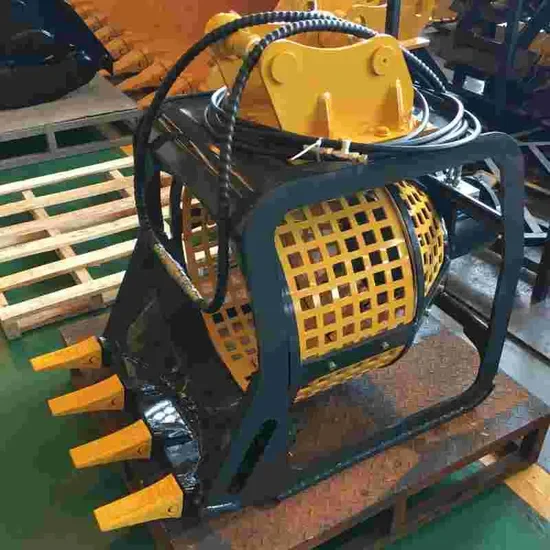
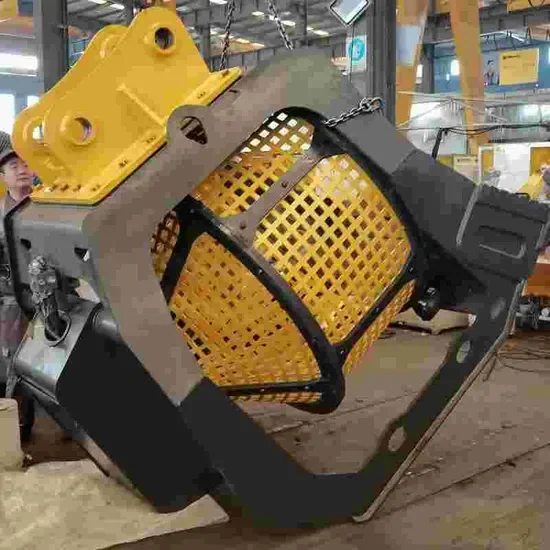
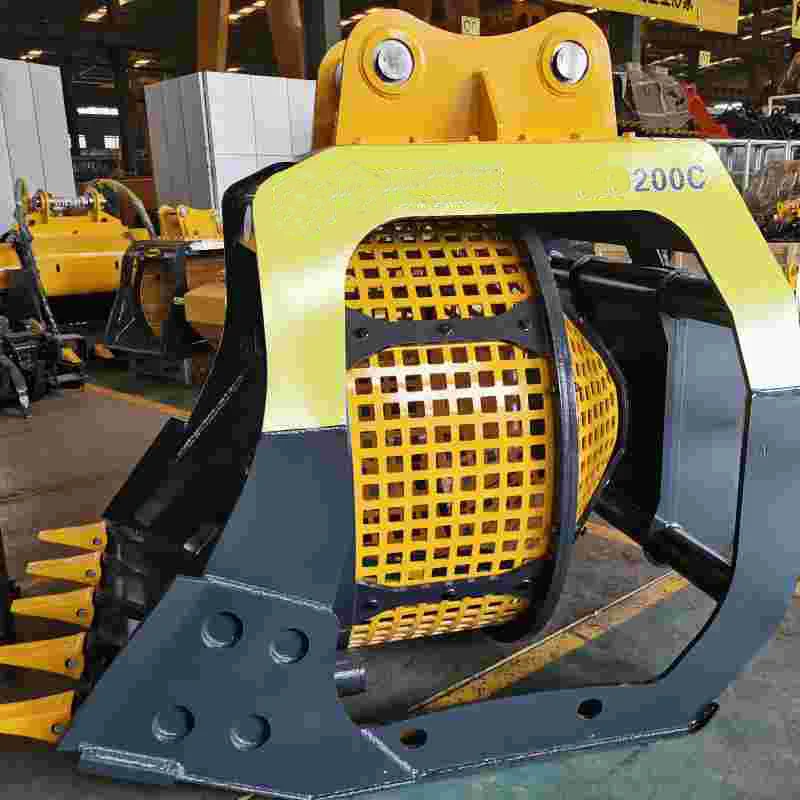
A rotary screening bucket carries a drum, round or polygonal, lined with mesh or perforated panels. A hydraulic motor turns the drum while the operator holds the bucket over a stockpile or a truck. Material tumbles inside the drum; pieces smaller than the panel opening fall through, and the oversize stays inside to be tipped out separately.
A screener does not change the size of anything. It sorts. Its output is set by the panel opening, and its speed depends on how freely the material flows. Dry, crumbly soil screens quickly; wet clay can blind the mesh and stall progress. The three PAB screeners on the site step from a 610 mm drum to a 1000 mm and a 1350 mm drum as the carrier class rises.
| Model | Carrier class | Drum | Flow | Weight |
|---|---|---|---|---|
| PAB02-3 | 3.5–5.5 t | 610 mm | 30 L/min | 245 kg |
| PAB12-1 | 12–17 t | 1000 mm, interchangeable | 80 L/min | 1020 kg |
| PAB16-3 | 18–23 t | 1350 mm | 110 L/min | 1920 kg |
Decision table: material problem to processing tool
The quickest way to choose is to describe the material you have and the material you want, then read across.
| Material you have | Material you want | Tool | Notes |
|---|---|---|---|
| Topsoil with stones and roots | Clean topsoil for reuse | Screening bucket | Panel opening sets the soil grade |
| Demolition concrete lumps | Recycled aggregate for fill | Crusher bucket | Remove large steel first with a pulverizer or shear |
| Trench spoil with cobbles | Backfill free of large stones | Screening bucket | Oversize can be stockpiled or crushed separately |
| Blasted rock with oversize | Smaller graded stone | Breaker, then crusher bucket | Break boulders to fit the crusher mouth |
| Crushed concrete with fines | Two clean fractions | Crusher, then screening bucket | Screen removes dust and fines from the crushed product |
| Very wet clay with stones | Usable fill | Neither works well when wet | Dry the material or use another method |
Worked example: demolition concrete on a 15-tonne excavator
A contractor demolishing a small slab wants to reuse the concrete as fill on the same site. The carrier is a 15-tonne excavator. The planning goes step by step.
- Reduce the slab to manageable pieces with a breaker or pulverizer, and pull out reinforcement as it is exposed.
- Choose a crusher bucket for the carrier. The SCB crusher bucket serves the 15 tonne class at 1,394 kg.
- Set the discharge for the size the fill specification asks for, starting coarser and adjusting after a trial batch.
- If the specification limits fines, screen the crushed product. The PAB12-1 suits 12–17 t carriers with an 80 L/min flow.
- Stockpile each fraction separately and keep steel in its own skip.
- Order spare jaw plates with the crusher and spare panels with the screen.
Changing between the two buckets is quicker with a quick coupler, but both still need the right hydraulic connections and flow, so check the auxiliary circuit for each before the job starts.
Worked example: garden topsoil on a compact excavator
A landscaper on a 4.5-tonne machine needs to strip a garden, keep the topsoil and remove stones and roots. No size reduction is needed, only separation, so a screening bucket is the right tool.
- The PAB02-3 screener serves 3.5–5.5 t carriers with a 610 mm drum and a 30 L/min flow.
- Check that the carrier’s auxiliary circuit supplies that flow and can run the drum motor in both directions if reversing is wanted to clear jams.
- Screen when the soil is reasonably dry; wet topsoil clogs the panels and slows output.
- Load the drum part-full; overfilling reduces tumbling and lets fines ride out with the stones.
- Tip the retained stones and roots to a separate pile for disposal or other use.
The topsoil screening workflow covers stripping, screening and stockpiling in more detail.
What slows each bucket down on site
| Factor | Effect on a crusher bucket | Effect on a screening bucket |
|---|---|---|
| Moisture and clay | Material packs in the jaws | Mesh blinds and fines stay in the drum |
| Oversize feed | Pieces bridge across the mouth | Large stones batter panels |
| Steel or timber | Rebar wraps, timber does not break | Long pieces tangle in the drum |
| Fine setting or opening | Lower output per hour | Slower passing, cleaner product |
| Overfilling | Jaws choke and stall | Material slides instead of tumbling |
| Low hydraulic flow | Slower jaw stroke | Slower drum rotation |
Production planning should allow for these factors. Feeding at a steady rate, keeping the material dry where possible and pre-sorting obvious contaminants usually help more than a larger bucket.
Setting the crusher gap and choosing the screen opening
Both attachments are tuned by one number. On the crusher it is the discharge gap; on the screener it is the panel opening. Choose them from the product specification, not from the largest setting the attachment offers.
- Write down the largest particle the end use allows, for example the maximum stone size in a fill or a pipe-bedding specification.
- For crushing, start with a gap at or slightly below that size, crush a trial batch and measure the largest pieces in the output.
- Adjust the gap in small steps; a tighter gap lowers output per hour and raises jaw wear.
- For screening, choose a panel opening at the largest particle the product may contain.
- Run a trial and check how much good material is leaving with the oversize; if it is a lot, the material may be too wet rather than the opening too small.
- Record the final setting and opening on the job sheet so the next batch starts from a known point.
Where two products are needed from one pile, such as a coarse fill and a fine bedding layer, a second screening pass at a smaller opening is often simpler than trying to hit both with the crusher setting.
Selection mistakes that cost time on site
| Mistake | What happens | Better choice |
|---|---|---|
| Buying a crusher to clean topsoil | Soil is crushed with the stones, roots wrap the jaws | Screening bucket at the right opening |
| Buying a screener for oversize rock | Rock stays in the drum and must be handled again | Crusher bucket, with a breaker for boulders |
| Choosing by bucket size, not carrier class | Carrier overloaded or flow too low | Match the listed carrier range first |
| Ignoring the hydraulic return | Heat build-up and slow motor | Check return and case drain needs |
| Feeding steel-rich demolition rubble | Jaw jams and stoppages | Separate steel with a pulverizer or shear first |
| No spare jaws or panels on the order | Job stops at the first worn part | Order wear parts with the attachment |
Most of these mistakes come from writing the attachment order before the material order. Describing the material first, as this guide recommends, prevents them.
Hydraulic requirements for crushers and screeners
Both attachments run a hydraulic motor from the excavator’s auxiliary circuit, but their demands differ. A crusher bucket needs enough flow to keep the jaw stroking and enough pressure to break the material; it often benefits from a case drain or low-restriction return, depending on the motor design. A screening bucket usually needs less pressure, and a reversible circuit helps clear jammed drums.
- Confirm flow and pressure against the attachment’s data before ordering.
- Check whether a case drain line is required and whether the machine has one.
- Confirm two-way flow if the drum or jaws are to be reversed.
- Match hose ends and lengths to the auxiliary couplers; the hydraulic hose specification guide explains how.
- Follow the attachment manual for start-up and pressure checks.
Wear parts and running costs
Crusher bucket wear concentrates on the jaws. Many jaw plates can be turned end for end when the lower section wears, which extends their life before replacement. Side liners and bearings follow. Abrasive natural rock wears jaws faster than most demolition concrete.
Screening bucket wear concentrates on the panels and the drum drive. Mesh wears and tears from stones and roots; drum bearings and seals suffer from fine dust. Keeping the drum clean after each shift and checking panel fixings protects both.
- Crusher: jaw plates, side liners, setting spacers, bearings and seals.
- Screener: panels at the chosen opening, a spare set at a second opening, drum bearings and drive parts.
- Both: hose pair, quick-coupler pins and grease for the pivots.
Crushing and screening questions
Can a screening bucket break rocks?
No. A screening bucket only separates material by size through its panels. Rocks larger than the opening stay inside the drum and are tipped out whole. If the job needs smaller stone, use a crusher bucket, and screen afterwards if separate fractions are needed.
Can a crusher bucket handle concrete with rebar?
Small pieces of reinforcement often pass through, but long bars can wrap around the jaws or jam the discharge. Removing large steel first with a pulverizer or shear protects the crusher and gives cleaner aggregate. Follow the crusher maker’s guidance on steel content.
What output size does a crusher bucket produce?
The discharge setting sets the largest piece leaving the bucket, but the product is a range of sizes below that setting, including fines. If a specification needs a narrow size range, screen the crushed material to remove fines or oversize.
Can one excavator run both a crusher and a screener?
Yes, if the carrier sits in both attachments’ weight classes and its auxiliary circuit supplies the flow, pressure and return each one needs. A quick coupler speeds the change between buckets, but hoses and couplers must suit both.
Is the HWPD40 crusher suitable for a 20-tonne excavator?
No. The HWPD40 is listed for 30–40 tonne excavators and weighs 3,500 kg, which is beyond what a 20-tonne carrier is meant to handle. For smaller carriers, choose a crusher listed for that class, such as the SCB model for 15-tonne machines, and confirm the hydraulic data before ordering.
Why does my screening bucket clog?
Wet or clay-rich material sticks to the mesh and blinds the openings. Overfilling also stops the material from tumbling. Screen drier material, feed smaller loads and reverse the drum if the attachment allows it. A larger opening helps if the product specification permits.
Should I buy a crusher bucket or hire a mobile crusher?
It depends on volume and site space. A crusher bucket suits smaller volumes, tight sites and jobs where the excavator is already present. A tracked mobile crusher has much higher output for large volumes. Compare the tonnage to process with the bucket’s practical output before deciding.
What should I send to choose between a crusher and a screener?
Describe the source material, the largest piece size, the target product and its use, the moisture and clay content, and the excavator model and auxiliary flow. Photos of the material help. With that information the right tool, or both, can be chosen.