
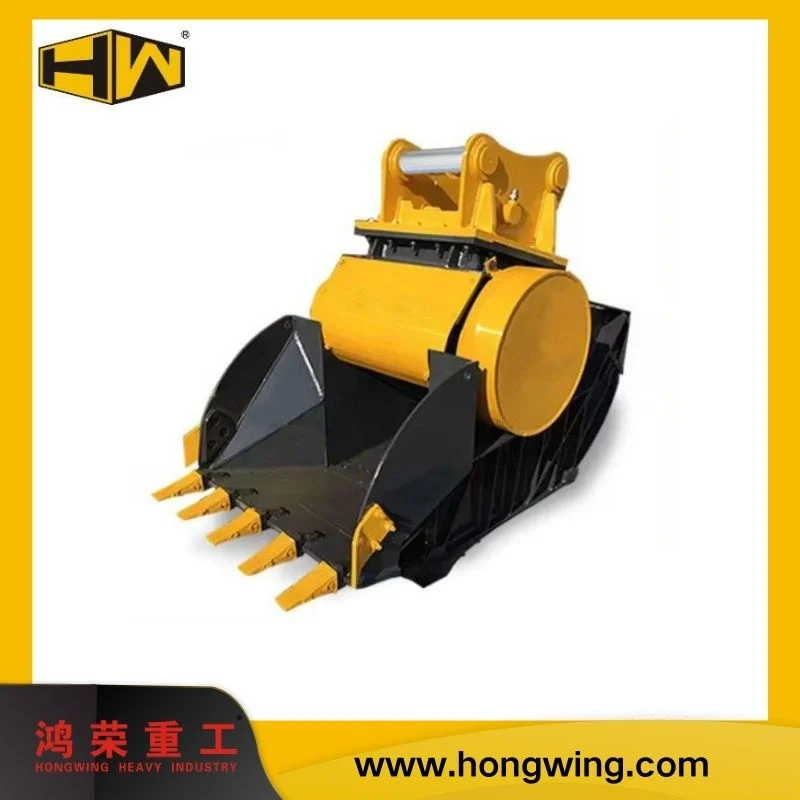
Excavator Crusher Buckets for Rock & Concrete
HWPD40 Crusher Bucket — 30–40 Tonne Excavators
900 × 520 mm feed specification, 12–120 mm discharge adjustment and 3500 kg weight.
12–120 mm discharge adjustment
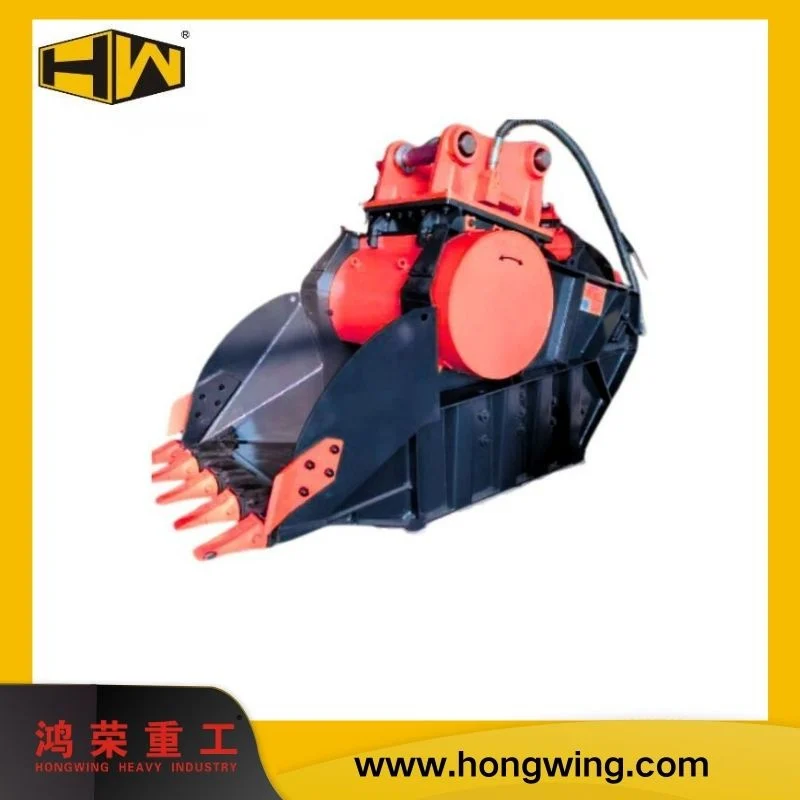
Excavator Crusher Buckets for Rock & Concrete
Hongwing SCB 15T is a hydraulic jaw crusher bucket for 15 tonne excavators. The 1, 394 kg attachment processes stone and concrete at the excavation site. It suits a material-processing setup where the excavator loads and crushes material close to the place where the aggregate will be used.
| Model / part number | SCB-15T |
|---|---|
| Excavator class | 15 t |
| Weight | 1394 kg |
| Crushing mechanism | Hydraulic jaw crusher |
SCB 15T is the compact Hongwing jaw-crusher configuration in this catalog, weighing 1, 394 kg. Its task is to reduce inert rock or concrete at the excavator’s working position, rather than haul every load to a remote crusher. Organise the job around feed preparation, crushing and the destination of the reused material.
| Stage | Equipment or action | Purchasing decision |
|---|---|---|
| Sort | Separate soil, metal and unwanted debris | Material entering the jaw |
| Prepare | Break oversize pieces where needed | Breaker and crusher sequence |
| Reduce | Jaw-crusher bucket on the excavator | Required feed and finished material |
| Grade | Screen the crushed fraction | Screen-opening requirement |
| Reuse | Place material in the specified work | Target grading and receiving location |
A crusher order needs two material descriptions. The feed description includes rock or concrete type and the largest pieces reaching the jaws. The output description includes the required grading and its use, such as backfill or a site road. A jaw setting describes the discharge opening; a screening operation separates a target fraction after crushing.
The fixed and moving jaw plates are wear components. Keep their plate profiles and mounting details with the crusher identity. A project order can include a replacement jaw set, mounting bolts and the maintenance items specified for the drive assembly; these should appear separately from the bucket body and excavator mounting.
The 1, 394 kg SCB 15T is the 15 tonne configuration. HWPD40 is the 30–40 tonne, 3, 500 kg unit with a 900 × 520 mm feed-size specification and a 12–120 mm discharge adjustment. Moving to the larger model changes the carrier and the material route, rather than just the purchase price.
The SCB order here is Hongwing’s 15 tonne, 1,394 kg configuration. MB BF60.1 S4 is a separate jaw-crusher product for 10–18 tonne carriers, weighing 1,650 kg and using the hydraulic/feed configuration below. Use that independent model to compare the complete crusher purchase: bucket body, carrier adapter, hydraulic circuit and replacement jaws.
| Parameter | BF60.1 S4 |
|---|---|
| Carrier / bucket mass | 10–18 t / 1,650 kg |
| Loading capacity | 0.55 m³ |
| Crusher mouth | 610 × 500 mm |
| Oil flow | 120–150 L/min |
| Working pressure | 220–280 bar |
| Return pressure | Less than 10 bar |
| Envelope A / B / C | 1,000 / 1,745 / 1,100 mm |
The SCB-15T is sized for the excavators that already work on most small and medium demolition and groundwork jobs. A 15-tonne machine travels on a standard low-loader, fits through site gates that a large carrier cannot, and can work alongside neighbouring buildings. Putting a jaw crusher on that machine means rubble from a house, a small commercial building or a yard can be crushed where it lies and placed back as fill or a working platform.
The limit is volume. A crusher bucket on a 15-tonne carrier processes one bucketful at a time, so very large stockpiles are better handled by a larger unit such as the HWPD40 for 30–40 tonne excavators or by a dedicated crusher.
This page lists the carrier class, the 1394 kg weight and the hydraulic jaw mechanism. The installation also depends on figures that should be confirmed for the exact unit when quoting. Ask for them rather than assuming values from another crusher.
| Item | Listed on this page | Confirm before ordering |
|---|---|---|
| Carrier class | 15 t | Your machine’s operating weight and arm length |
| Bucket weight | 1394 kg | Lift chart with bucket, bracket and a full load at working reach |
| Feed opening | Not listed | Mouth dimensions against your largest pieces |
| Discharge adjustment | Not listed | Range and method of adjustment for the product you need |
| Oil flow and pressure | Not listed | Drive requirement against the auxiliary circuit |
| Return and drain | Not listed | Return-line back-pressure limit and any drain connection |
| Mounting | Carrier bracket in the package | Pin diameters, centres, ear width or coupler model |
A loaded crusher bucket is one of the heaviest things a 15-tonne excavator will hold at reach. Work with the bucket over the front of the tracks where the machine is most stable, keep the feed pile and the product pile close, and swing rather than travel between them. If the machine rocks when the bucket is full and extended, reduce the fill or bring the work closer.
Hydraulics are the other constraint. Many 15-tonne machines have an auxiliary circuit set up for a breaker. A crusher motor runs continuously rather than in short bursts, so it heats the oil more, and it usually needs a low-pressure return. Watch the oil temperature during the first long session, keep the cooler clean, and stop if the temperature climbs beyond the excavator manufacturer’s limit. Where the excavator also runs a hammer for pre-breaking, record both sets of auxiliary settings so the operator can switch correctly.
For a broader comparison of crushing and screening on small sites, see the crusher bucket overview.
A jaw crusher reduces material through its jaw mechanism. A screening bucket separates material by its screen openings. Crushing and screening can be consecutive stages in the same recycling route.
The 15 tonne configuration has a 1, 394 kg empty weight. The excavator then handles the mounting assembly and the material held in the bucket.
The jaw is selected against the actual feed pieces and material type. A photo with a size marker shows the largest pieces and attached debris, while the output specification describes what the site intends to reuse.
List the fixed and moving jaw plates with their fasteners, followed by drive-service parts identified for the assembly. Keeping those components separate from the bucket body makes the replacement order repeatable.
It is listed for the 15-tonne class. Machines close to that weight may suit it, but a lighter carrier will be less stable with a loaded bucket at reach, and a heavier one may need a different bracket. Send the excavator model, operating weight, pin dimensions and auxiliary circuit details for a fitment check before ordering.
Cold, broken asphalt can typically be crushed in a jaw crusher bucket, but asphalt softens in warm weather and can stick in the jaws and discharge. Crush it in cool conditions, keep it separate from concrete if the product specification requires, and check any local rules on reusing asphalt before placing the crushed material.
For small and medium volumes, a crusher bucket on an excavator that is already on site avoids the mobilisation of a separate plant and its feed machine. For large volumes, a mobile crusher usually produces far more per hour. The right choice depends on tonnage, site space and how long the excavator can be dedicated to crushing.
900 × 520 mm feed specification, 12–120 mm discharge adjustment and 3500 kg weight.
Send your machine model, required quantity and destination. Add installation items, wear parts and service quantities to the same inquiry.