Record the hose size and finished length
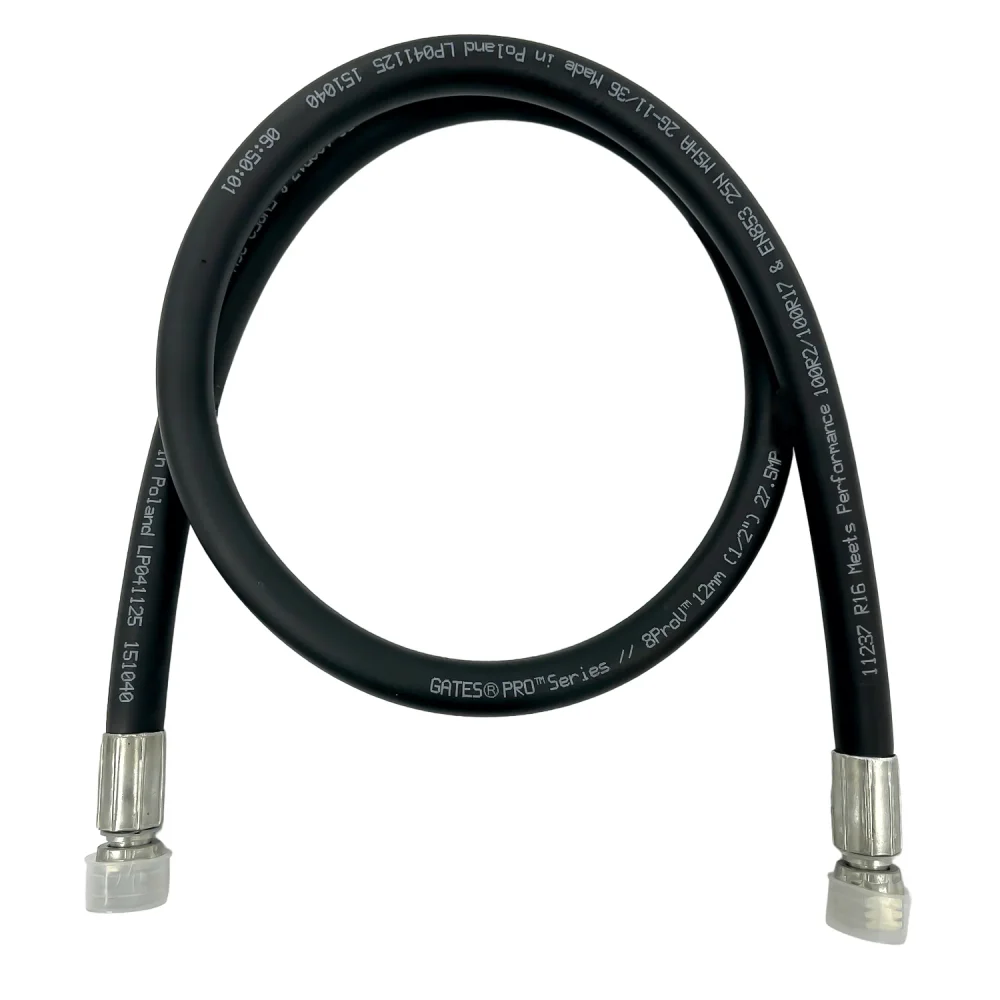
Read the hose marking where it is legible and record the internal diameter. Add the overall route and space available around the hose. For a replacement, photograph the complete assembly laid out so both ends can be identified.
Mark the exact endpoints used for your length measurement on a sketch. Straight and angled fittings can use different measurement conventions, so request a dimension drawing that shows how the finished assembly length is defined.
Identify each end separately
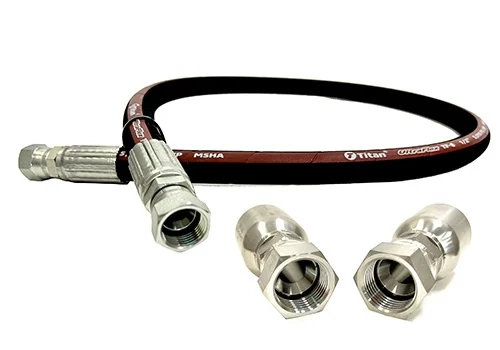
Label the ends A and B. For each, record male or female form, thread size and pitch, sealing style, straight or angled shape, and whether it swivels. A matching thread alone does not establish a matching seal.
Take a close-up of each sealing face and a side view of each fitting. If both ends are angled, show their relative orientation in a sketch or photograph and ask for that orientation to be stated on the assembly drawing.
Provide the operating conditions
State the working pressure and any known pressure peaks, the fluid, fluid temperature and surrounding temperature. Include movement, rubbing points, exposure and the available bend space. These conditions determine the hose and fitting combination to be considered.
Specify working pressure when comparing assemblies. Ask the supplier to identify the hose, fitting and assembly rating for the offered configuration, along with any test and identification requirements you need.
Use catalogue examples as complete configurations
A half-inch by 48-inch assembly with JIC female ends describes a different purchase from a three-quarter-inch by 72-inch assembly. Keep diameter, length, thread and working-pressure information together on each quote line.
If you are seeking another manufacturer’s equivalent, send the functional specification and photographs rather than assuming the original seller’s stock code identifies the new assembly. Request the supplied manufacturer’s own reference and drawing.
Prepare a hose order line
One well-labelled sketch can capture the connections and dimensions that are difficult to describe in text. Add the quantities, protective covering required and destination, then keep the confirmed assembly drawing for repeat orders.
- Internal diameter and clearly defined finished length.
- End A and end B: thread, sealing face, fitting angle and swivel form.
- Relative orientation where two angled ends are used.
- Working pressure, fluid and temperature range.
- Routing, movement, bend space, protection and test requirements.