
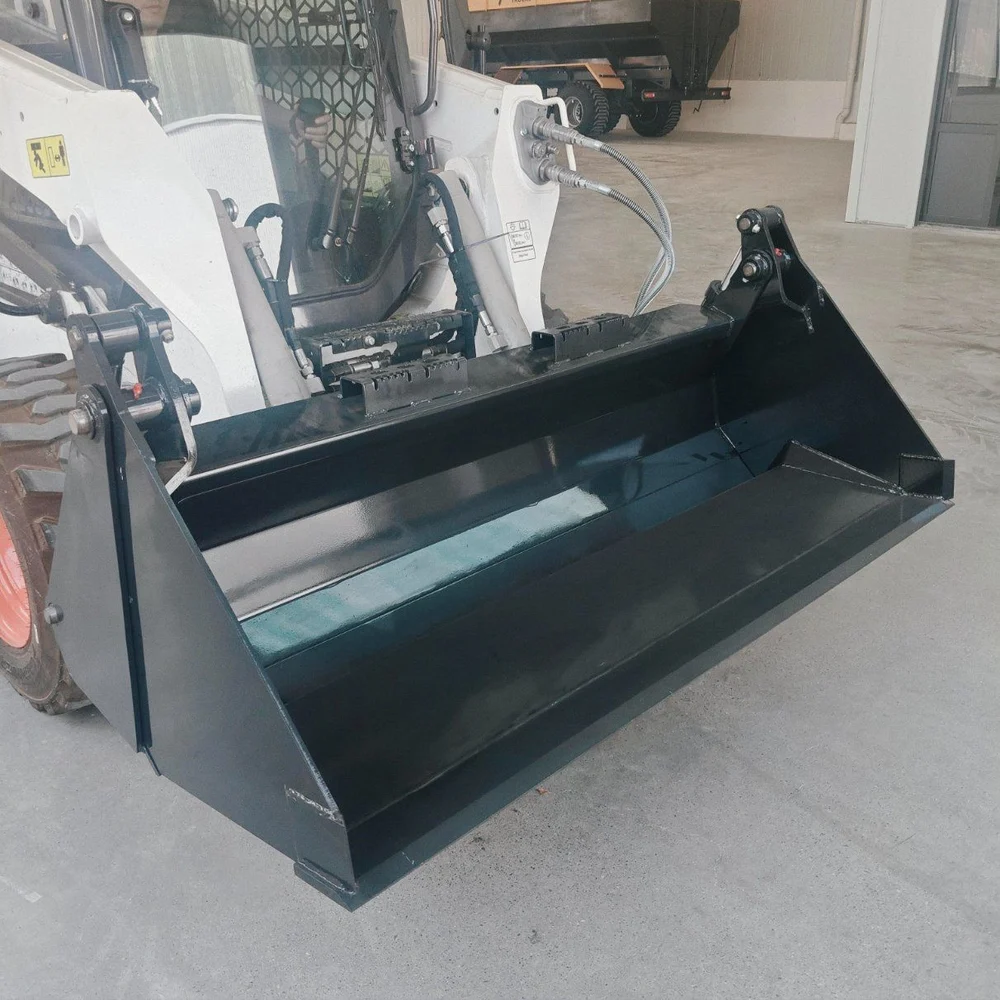
4-in-1 Buckets for Skid Steers & Wheel Loaders
HY010472 4-in-1 Skid Steer Bucket — 0.48 m³
Hydraulic combination bucket for loading, levelling, grabbing and unloading with a skid steer.
0.48 m³ · four functions
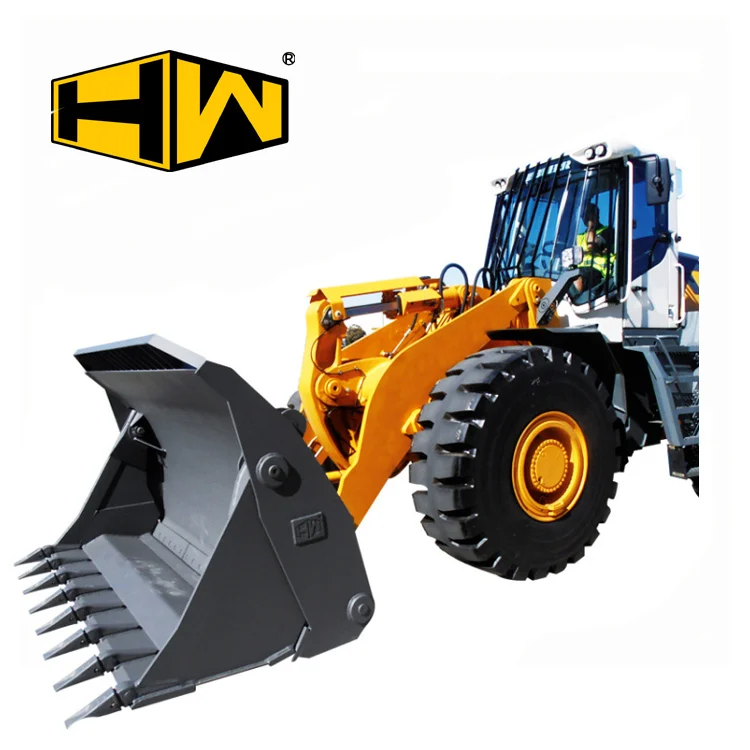
4-in-1 Buckets for Skid Steers & Wheel Loaders
HWN98789 is a 1 m³ four-in-one wheel-loader bucket, 2, 000 mm wide and 800 kg empty. Two cylinders move the opening section for loading, dozing, levelling and gripping. The supplier’s 2 tonne loader class describes rated load; the machine linkage and auxiliary cylinder connections form the mounted configuration.
| Model / part number | HWN98789 |
|---|---|
| Bucket capacity | 1 m³ |
| Bucket width | 2000 mm |
| Weight | 800 kg |
| Opening cylinders | 2 |
| Functions | Bucket loading, dozing, levelling and grabbing |
| Material selection | Q355B / NM400 |
| Loader rated-load class | 2 t |
The closed jaw carries loose material as a loading bucket. Opening the section exposes an edge for pushing and levelling; closing around an object creates the gripping action. Two cylinders operate the opening section, while the loader linkage rolls the complete bucket back and dumps it forward.
Volume and load mass are separate decisions. A 1 m³ fill at 1.2 t/m³ adds 1.2 t of material, giving 2.0 t with the empty bucket before mounting items. At 1.6 t/m³, the same volume gives a 2.4 t assembly. Material density therefore matters alongside the loader’s rated-load configuration.
| Material bulk density | 1 m³ fill | Fill + 800 kg bucket |
|---|---|---|
| 1.2 t/m³ | 1, 200 kg | 2, 000 kg |
| 1.6 t/m³ | 1, 600 kg | 2, 400 kg |
| 2.0 t/m³ | 2, 000 kg | 2, 800 kg |
A straight edge gives a continuous surface for spreading and finishing. Teeth concentrate entry into compacted material. Put the selected edge system, replacement edge or teeth, and fasteners on the same order as the body. Q355B / NM400 material selections belong on the construction drawing.
HWN98789 is the wheel-loader combination bucket. HY010472 is the 0.48 m³ skid-steer configuration. The two products differ in linkage, working envelope and capacity; a wider or larger bucket does not describe a mounting conversion. List the loader model, linkage dimensions, two-cylinder hose arrangement and full jaw envelope together.
| Choice | Initial order | Repeat order |
|---|---|---|
| Straight edge | Smooth loading/levelling face | Matched edge and fastener pattern |
| Toothed edge | Selected adapter/tooth system | Tips and retaining sets by that system |
| Opening jaw | Two cylinders and linked pivot assembly | Two cylinder positions, seals and joint components |
| Wheel-loader mount | Linkage and jaw hose connections | Mounting pins/bushes and hose ends |
HWN98789 is listed for the 2 t rated-load loader class. In Chinese loader naming that class is commonly labelled ZL20, and many compact articulated loaders sold elsewhere sit in the same band. The rated-load class tells you the machine size; it does not prove the bucket will hang on your arms. Fit is decided by the linkage, so measure the loader before ordering.
| Measurement | Where to take it | What it controls |
|---|---|---|
| Lower hinge pin diameter | Bucket pivot pins at the end of the loader arms | Bore of the lower mounting bosses |
| Upper link pin diameter | Tilt link or tilt-cylinder connection | Bore of the upper bosses |
| Vertical pin centres | Centre of lower pin to centre of upper pin | Rollback and dump angles with the new bucket |
| Arm spacing | Outside and inside faces of the two loader arms | Position of the mounting ears across the 2,000 mm back |
| Ear gap | Inside width between each pair of ears on the old bucket | Spacer and shim requirement |
| Quick coupler | Coupler make and model, if one is fitted | Hook and pin positions in place of pin-on bosses |
Then check the hydraulics. The two opening cylinders need a third valve section on the loader with a pair of lines run to the arm ends. If the loader has only lift and tilt functions, a third-valve kit has to be fitted before the jaw can work. Finally, compare the 2,000 mm width with the outside width of the front tyres. The bucket should cover the tyre track so the loader runs on ground it has just levelled.
A wheel loader’s rated load is quoted with its standard bucket fitted. Any attachment heavier than that standard bucket takes the difference off the payload. HWN98789 weighs 800 kg empty, and a four-in-one is usually heavier than the plain bucket it replaces because of the second shell, hinge line and cylinders. Weigh or look up the original bucket, subtract it from 800 kg, and remove the result from the 2 t rating.
| Step | Figure | Note |
|---|---|---|
| Loader rated load | 2,000 kg | With the standard bucket fitted |
| Extra attachment mass | 800 − 450 = 350 kg | Use the real mass of your original bucket |
| Remaining payload | 1,650 kg | Material the bucket should carry |
| Full fill at 1.6 t/m³ | 1.03 m³ allowed | A level 1 m³ load of gravel is within the figure |
| Full fill at 2.0 t/m³ | 0.83 m³ allowed | Part-fill wet sand or dense fill |
The 450 kg figure is an assumption to show the method, not a property of any machine. A lighter original bucket gives a smaller payload. Fitting a quick coupler adds its own mass and moves the load forward, which reduces stability further, so include it in the sum. When the result is close, part-fill the bucket and keep the load low during travel.
Follow the loader maker’s procedure for changing attachments and the attachment supplier’s pin and torque instructions. Keep everyone clear of the jaw and linkage while the machine is running.
The specification lists Q355B and NM400 as the material selection. Q355B is a Chinese structural steel with a minimum yield strength of 355 MPa in thinner plate. It is tough, weldable with normal workshop practice and typically used for shells, side plates and mounting structures. NM400 is a wear-resistant plate with a nominal hardness around 400 HBW. It is typically used where material slides and scrapes, such as edges, side cutters and floor wear strips. Confirm on the construction drawing which plates are which, because that decides how the bucket is repaired.
On a 2 t loader, a four-in-one is usually bought for yard and site work where the machine moves between loading, scraping and handling during one shift. Good habits keep the hinge and cylinders in shape.
| Item | Typical interval | What to look for |
|---|---|---|
| Hinge pins | Grease every 8–10 operating hours | Fresh grease at both ends, no side play of the clam |
| Cylinder pins (both cylinders) | Grease every 8–10 operating hours | No knocking when the jaw reverses direction |
| Jaw hoses and fittings | Daily walkaround | Chafing at the arms, weeping at crimps, kinks at full rollback |
| Edge bolts | After the first day, then weekly | Loose or missing bolts, worn heads |
| Loading and dozing edges | Weekly measurement | Remaining edge depth against the replacement limit |
| Cylinder rods and seals | Weekly, and whenever the jaw drifts | Scoring, oil film, drift with the control centred |
Order seal kits from the markings on each cylinder and replace both cylinders’ seals together, so they continue to stroke at the same rate. Order cylinder seal kits and replacement hydraulic hose assemblies with the bucket if the machine works far from a workshop.
| Symptom | Likely cause | Check or action |
|---|---|---|
| Jaw twists or one side closes first | Air in one cylinder, bypassing seal, worn pin on one side | Cycle the jaw fully several times; then test each cylinder for internal leakage |
| Jaw drifts open while gripping | Cylinder seal bypass or leakage in the loader’s third valve | Cap the lines at the bucket to isolate the cylinders from the valve |
| Jaw moves slowly | Low flow from the third valve, kinked hose or coupler half-engaged | Check coupler seating and the valve setting |
| Jaw will not move | Couplers not connected, valve not selected, trapped pressure | Relieve pressure, reconnect and confirm the control is energised |
| Knocking at the hinge | Worn hinge pins or bushes | Measure pin and bore wear; replace as a set |
| Repeated hose damage | Hose too long or too short through the arm movement | Re-route and clamp; replace with the correct length |
The two combination buckets share a working principle but serve different machines. HWN98789 is the wheel-loader build. The 0.48 m³ HY010472 for skid steers is a separate design with a skid-steer plate. Neither converts to the other.
| Point | HWN98789 | HY010472 |
|---|---|---|
| Carrier | Wheel loader, 2 t rated-load class | Skid steer loader |
| Mounting | Wheel-loader linkage | Skid-steer attachment plate |
| Capacity | 1 m³ | 0.48 m³ |
| Width | 2,000 mm | From the configured drawing |
| Empty mass | 800 kg | From the configured drawing |
| Jaw drive | Two opening cylinders on the loader third valve | Cylinder and hose package on the skid-steer auxiliary |
| Typical setting | Yards, stockpiles, larger cleanup and truck loading | Landscaping, tight sites and lighter cleanup |
For background on carriers, densities and edge choices across the range, see the four-in-one bucket buyer’s guide.
No. The jaw cylinders open and close the bucket section. The loader linkage still controls rollback and forward dumping of the complete bucket.
Material density and attachment mass determine the loaded assembly. At 1.6 t/m³, 1 m³ of material plus the 800 kg bucket is 2.4 t before mounting items. Choose the fill and attachment combination against the loader configuration.
Teeth concentrate penetration into compacted material. A straight edge provides a continuous grading and spreading face. Include the corresponding replacement wear parts with the selected build.
List both cylinder seal sets, jaw pivot pins and bushes, hoses/end fittings, and the opening/loading cutting surfaces. Identify them by cylinder markings, pivot position and the bucket drawing.
It is listed for the 2 t rated-load wheel-loader class. No model list is published, so compatibility is confirmed by measurement: lower and upper pin diameters, vertical pin centres, arm spacing, ear gap and any quick coupler. Send those figures with the loader make and model, and the bucket mounting can be checked against the drawing before an order is placed.
Yes. The two opening cylinders need their own pair of hydraulic lines, separate from lift and tilt. Many loaders in this class have a third valve section as an option. If yours does not, a third-valve kit with lines to the arm ends must be fitted first. Tell us the coupler type at the arm ends so the bucket hoses can be supplied to match.
The loss equals the difference between 800 kg and the empty mass of your original bucket. Rated load is quoted with the standard bucket fitted, so extra attachment mass comes straight off the payload. If a quick coupler is added, include its mass too. Then divide the remaining payload by the material density to see how full the bucket can safely be.
It can be done, but it changes two things. The added steel reduces payload, and welding near NM400 plate needs preheat and low-hydrogen consumables to avoid cracking or softening. A bolt-on tooth bar or toothed edge chosen at ordering is usually the cleaner option. Ask for the edge drawing before modifying the bucket.
On a new installation the usual cause is air in one cylinder. Cycle the jaw slowly through its full stroke several times with no load until both sides move together. If it persists, check for a kinked hose, a coupler that is not fully seated, or a worn pin on one side. Uneven closing that develops later often points to a bypassing seal.
It can if the bucket is built with brackets that match the coupler’s hooks and locking pins, so give the coupler make and model rather than the pin-on dimensions. A coupler moves the load forward and adds mass, both of which reduce the usable payload. Confirm the coupler lock is fully engaged, as its manual describes, before lifting a gripped load.
Hydraulic combination bucket for loading, levelling, grabbing and unloading with a skid steer.
Send your machine model, required quantity and destination. Add installation items, wear parts and service quantities to the same inquiry.