
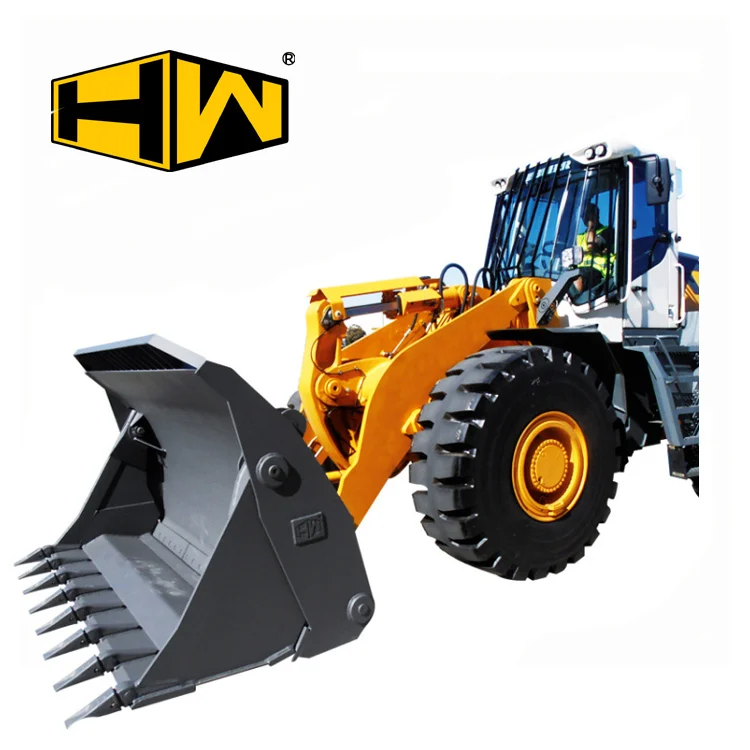
4-in-1 Buckets for Skid Steers & Wheel Loaders
HWN98789 1 m³ 4-in-1 Wheel-Loader Bucket
2000 mm wide, 800 kg combination bucket with two opening cylinders for the 2 tonne loader class.
1 m³ · 2000 mm width
4-in-1 Buckets for Skid Steers & Wheel Loaders
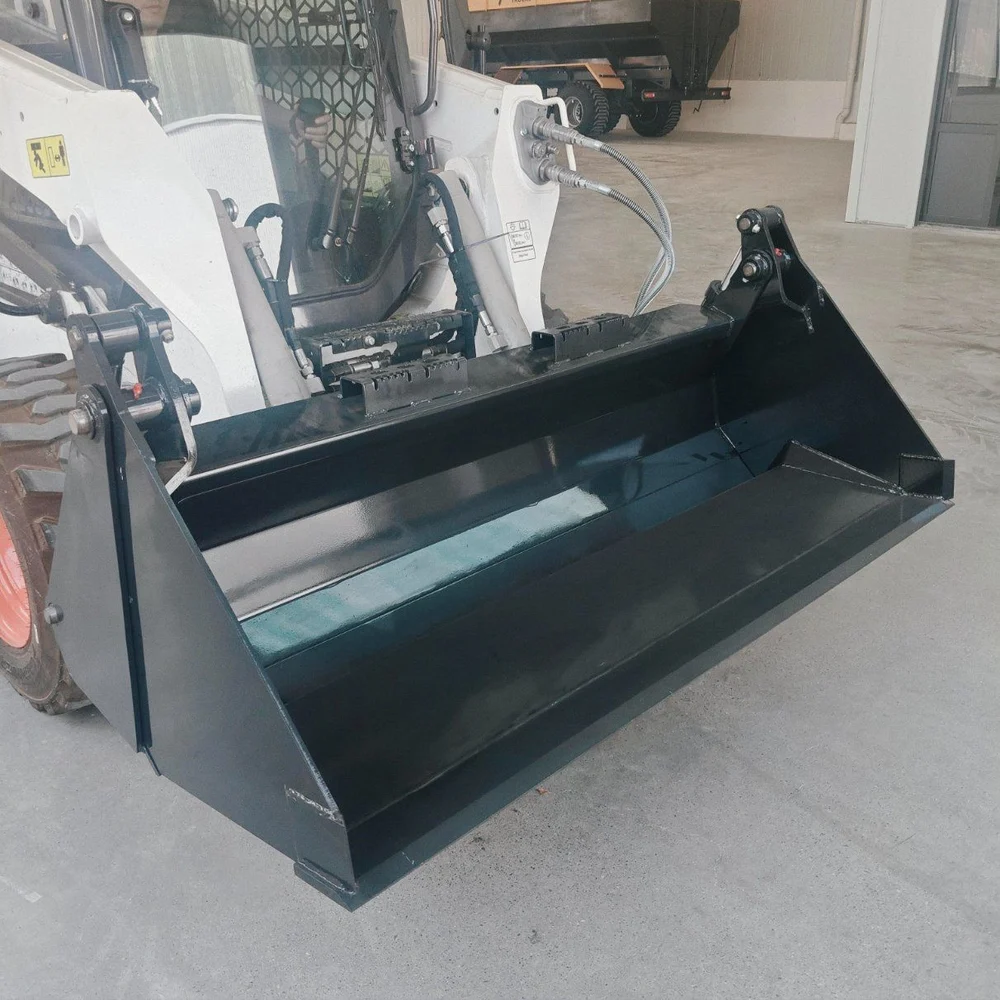
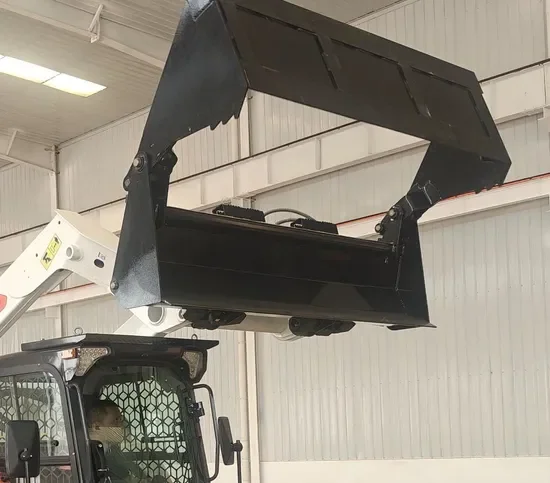
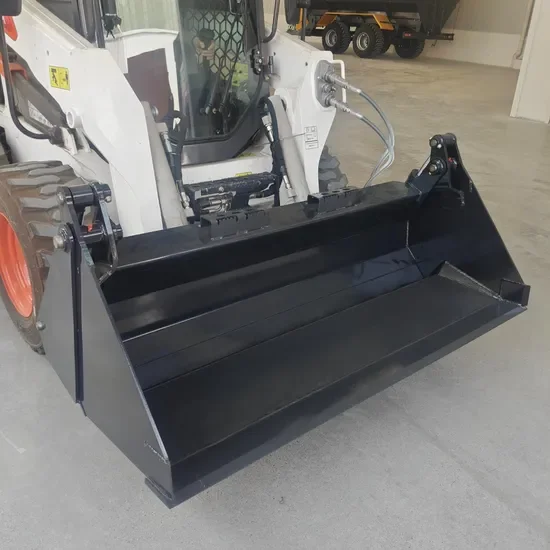
HY010472 is a 0.48 m³ four-in-one bucket for skid steer loaders. Its opening jaw turns the bucket into a combination tool for loading, levelling, grabbing and unloading. Order the mounting plate and hydraulic end connections with the bucket for the skid steer being used.
| Model / part number | HY010472 |
|---|---|
| Machine type | Skid steer loader |
| Bucket capacity | 0.48 m³ |
| Functions | Loading, levelling, grabbing and unloading |
With the jaw closed, HY010472 is a 0.48 m³ loading bucket. Opening the front section exposes the rear edge for dozing and profiling. Partially closing the jaw grips loose objects between the sections. Opening while unloading can place material beneath the bucket rather than using forward curl alone.
| Task | Jaw position | Purchase detail |
|---|---|---|
| Loading | Closed | Bucket capacity and cutting edge |
| Dozing / levelling | Open | Rear edge and wear surfaces |
| Gripping | Partly closed | Jaw opening and pivot layout |
| Controlled discharge | Open while raised | Cylinder and hose movement |
For a skid steer, working width is selected against the machine’s track or tyre width and the access lane. An overall width does not describe the open-jaw envelope. The order drawing needs the closed-bucket width, front-to-back depth, jaw opening and mounting-plate position. The hose route must move with the jaw while leaving the quick-disconnects accessible.
The 0.48 m³ capacity describes the bucket volume. At a specified material bulk density of 1.6 t/m³, 0.48 m³ corresponds to 0.768 t of material. The empty attachment is an additional load. Use the machine’s rated operating capacity and load position to choose the working combination. This calculation is useful for comparing material orders with different density, such as mulch and aggregate.
A combination bucket has more wear locations than a plain loader bucket: its loading edge, jaw edge, pivot assembly and cylinder connections all work through the opening cycle. List each edge and its fasteners separately, then add cylinder seals, pivot pins/bushes and the hydraulic connector set.
| Assembly | Record for the supplied bucket | Replacement order |
|---|---|---|
| Skid plate | Plate position, upper engagement and lock-slot arrangement | Mount/locking interface |
| Bucket body | Closed width, height and front-to-back depth | Loading edge and fasteners |
| Opening jaw | Opening, pivot centres and jaw-edge profile | Jaw edge, pivot pins and bushes |
| Cylinder circuit | Cylinder markings, hose lengths and connector ends | Cylinder seals and hose assemblies |
HY010472 mounts on a skid-steer attachment plate. On most full-size skid steers and compact track loaders that means the universal quick-attach interface: a top lip on the bucket plate hooks under the flange of the machine’s carrier, and two lower slots receive the machine’s lock pins or wedges, worked by hand levers or by a powered system. Mini and stand-on loaders use a smaller plate, so they need a different attachment.
Follow the skid steer maker’s attachment instructions for the exact locking check. A bent bucket plate or worn wedge will not lock reliably, so replace damaged mounting parts rather than forcing them.
The jaw cylinders connect to the front auxiliary couplers on the loader arm. Standard flow moves the jaw at a controllable speed; a high-flow circuit adds nothing for this attachment. Leave any case-drain coupler and attachment electrical connector unused, because the bucket has no motor and no electrical functions on the listed specification.
In imperial terms, 0.48 m³ is about 0.63 yd³ or 17 ft³. On a wheeled skid steer the published rated operating capacity is typically half of the tipping load; compact track loaders are rated at a smaller fraction of theirs. Either figure is quoted with a standard bucket fitted. A four-in-one is heavier than the standard bucket it replaces, so the usable payload falls by the difference. If the original bucket mass is unknown, count the whole HY010472 empty mass as load. That errs on the safe side.
| Material | Density used | Material in 0.48 m³ | ROC needed |
|---|---|---|---|
| Bark mulch | 0.4 t/m³ | 192 kg | 192 kg plus bucket mass |
| Moist topsoil | 1.4 t/m³ | 672 kg | 672 kg plus bucket mass |
| Road base or gravel | 1.6 t/m³ | 768 kg | 768 kg plus bucket mass |
| Wet clay or sand | 2.0 t/m³ | 960 kg | 960 kg plus bucket mass |
Take the bucket mass from the configured drawing supplied with the quote. Load position matters too. Opening the jaw while raised swings the clam and any remaining material forward, so release loads with the arms as low as the job allows and never open a full jaw at height on a slope.
Select the HY010472 working width against what the machine actually rolls on. A bucket narrower than the tyres leaves the wheels running in uncut ground, which spoils grading. Measure across the outside of both tyres, or both tracks, at their widest point.
| Job | Jaw use | Practical tip |
|---|---|---|
| Spreading topsoil or mulch in beds | Open slowly while reversing | Gives an even strip without tipping a heap that needs raking |
| Backfilling around footings and walls | Open fully and push | Stay square to the wall so the rear edge does not gouge it |
| Picking up landscape rock and kerb | Close on the piece | Grip near the middle and set down before re-gripping |
| Strip-out debris and timber offcuts | Close on mixed loads | Shake out soil before loading a skip |
| Final grade for paving or turf | Slightly open, back-drag | Use float and light passes; turn on hard ground, not the finished surface |
| Loading a skip or tipper | Open over the body | Saves full dump angle on a machine with limited lift height |
Skid-steer turning scrubs the surface. Plan grading passes so the machine turns on ground that will be worked again, and finish with straight reversing passes.
Record which edge wears faster. Grading-heavy work wears the jaw edge first, loading wears the main edge, and that decides which spare to keep in the van.
| Complaint | Usual reason | What to do |
|---|---|---|
| Couplers will not connect | Pressure trapped in the hoses or machine lines | Relieve pressure as the operator manual describes, then reconnect |
| Jaw moves the wrong way | Hoses connected to opposite couplers | Swap the hoses at the couplers |
| Jaw keeps moving without input | Auxiliary left in continuous-flow detent | Switch detent off and use momentary control |
| Jaw slow on cold mornings | Cold, thick hydraulic oil | Warm the machine up before working the jaw |
| Jaw drifts open under load | Worn cylinder seals or valve leakage | Check the rod seals, then the machine’s auxiliary valve |
| Clam knocks when reversing direction | Worn pins or bushes at the hinge or cylinders | Measure wear and replace pins and bushes together |
HY010472 is the skid-steer combination bucket in this range. It is not a smaller version of the HWN98789 wheel-loader four-in-one, which hangs on loader linkage, holds 1 m³ and uses two opening cylinders. For other skid-steer jobs, two neighbouring attachments are worth comparing.
| Attachment | Listed size | Strongest use |
|---|---|---|
| HY010472 4-in-1 bucket | 0.48 m³ | Loading, dozing, grading and grabbing with one tool |
| MAXX 5643D1 side dump bucket | 0.60 yd³ | Discharging sideways into trenches and along kerbs |
| Wolverine 72-inch grapple bucket | 44-inch opening | Brush, logs and bulky debris that need a strong clamp |
For carrier types, density planning and edge choice across combination buckets, see the 4-in-1 bucket category guide.
No. It is bucket volume. Material mass is volume multiplied by bulk density, and the attachment adds its own empty mass. A 0.48 m³ fill at 1.6 t/m³ is 768 kg of material.
The jaw is cylinder-operated rather than a continuously driven motor. The purchase package needs the opening/closing auxiliary connections, cylinder assembly, hoses and quick-disconnect ends.
The jaw circuit controls opening and closing. The skid steer’s bucket linkage controls rollback and forward dump of the complete attachment. These are separate movements.
HY010472 is a 0.48 m³ skid-steer configuration. HWN98789 is a 1 m³ wheel-loader configuration with a different mounting and machine load class. Capacity alone does not describe an interchangeable attachment.
Size it on rated operating capacity rather than on engine power. Add the bucket’s empty mass from the drawing to the mass of the material you move most, for example 768 kg for a full load at 1.6 t/m³, and check the total sits within the machine’s published capacity. Then check that the bucket width covers the tyres or tracks and that the machine has front auxiliary hydraulics.
No. Continuous flow suits motor-driven tools such as augers and brush cutters. The jaw is cylinder-driven, so in detent the cylinders reach the end of stroke and oil passes over the relief valve, heating the system and keeping pressure on the hoses. Use the momentary or proportional auxiliary control so the jaw moves only while you command it.
Yes, if the track loader has the same skid-steer attachment plate and front auxiliary couplers. Track loaders are rated at a smaller fraction of their tipping load than wheeled skid steers, so recheck the payload figure against the track loader’s own rated operating capacity. Measure the track width too, since many track loaders are wider than a wheeled machine of similar size.
Usually because pressure is trapped in the hoses or the machine lines. Heat from sun on a parked bucket raises it further. Stop the engine and relieve auxiliary pressure using the method in the operator manual, clean both coupler faces and push them together squarely. Do not loosen fittings under pressure to release oil.
About 0.63 cubic yards, or roughly 17 cubic feet. US suppliers often state skid-steer bucket capacity in cubic yards, so this helps when comparing listings. Both figures describe volume only. The load the machine carries depends on material density and the bucket’s own mass, not on the capacity number.
Often, if the loading edge has a bolt pattern that matches the tooth bar. Confirm the edge bolt spacing and hole size from the configured drawing before buying one. A tooth bar helps the bucket enter compacted ground and clay, but it adds mass, moves the cutting line forward and leaves grooves when back-dragging. Remove it for finish grading and fit it again for digging work.
Set it down on firm, level ground with the jaw closed and the machine’s locks released only after the bucket is resting. Relieve auxiliary pressure, disconnect the hoses, fit the dust caps and hang the hoses clear of the ground. Grease the hinge before a long idle period so moisture does not sit on bare pins.
2000 mm wide, 800 kg combination bucket with two opening cylinders for the 2 tonne loader class.
Send your machine model, required quantity and destination. Add installation items, wear parts and service quantities to the same inquiry.