Choose orientation around the loading point
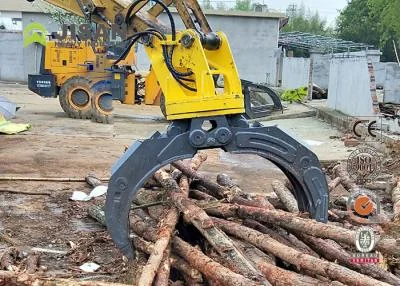
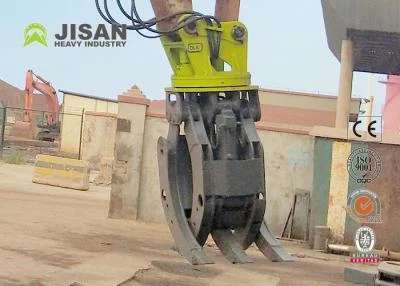
Picking up a log and placing it in a truck are different movements. A fixed grapple uses the excavator’s position to orient the load. A rotating grapple turns it independently, helping align timber with the receiving stack or truck bed.
Two grapple configurations, different machines
JSG-DL20 is the fixed 20 tonne configuration with a 1,500 mm opening and 1,450 kg attachment weight. JSG-DL36 is the rotating 36 tonne configuration with a 1,800 mm opening and 2,100 kg weight. The rotating model also has a higher hydraulic-flow demand.
Sketch the yard and the reach
Show the pickup pile, travel area, truck position and loading height. Add typical log length and mass. The excavator lift chart must account for the grapple, bracket and log together at the working reach.
Order gripping and rotation controls together
A rotating grapple needs both functions represented in the hydraulic connections and cab controls. Add cylinder seals, linkage pins, bushes and rotator service items to the replenishment list.
Vegetation and stump work around the timber-handling area
Cutting brush, mowing a bank, mulching woody growth and grinding a stump use different cutting mechanisms. A skid-steer working head and an excavator-mounted head also have different installation and carrier requirements. Keep those jobs separate from the fixed or rotating log-grapple purchase.
| Job | Working head | Carrier / working fields |
|---|---|---|
| Rotary brush cutting | Wolverine 72-inch-labelled brush cutter | Skid steer; 66 in cut; 14–20 US gpm; two blades |
| Bank / verge mowing | FAE PML/HY70 | 2–3.5 t excavator; 700 mm; 19–40 or 38–60 L/min motor options |
| Woody-vegetation mulching | FAE UML/SSL/VT150 | Skid steer; 1582 mm; 115–200 L/min; fixed-tooth rotor |
| Stump cutting | Wolverine stump grinder | Skid steer; 25 in wheel; 32 teeth; 15–30 US gpm |
Excavator log loading cycle: pick, orient, lift and place
Log loading looks simple, but cycle time and safety both depend on the order of movements. An experienced operator keeps each cycle short and the load low.
- Approach the pile with the grapple open and square to the logs, close to the ground.
- Grip near the balance point of the log or bundle so it hangs level. Gripping at one end makes it swing and see-saw.
- Lift only as high as needed to clear the pile and the truck bolsters.
- Orient the load. With a fixed grapple, swing and position the machine; with a rotating grapple, turn the logs while the house swings.
- Lower the logs into the bunk or stack and open the jaws only when the load is resting.
- Return with the grapple open, ready for the next pick.
Keep the truck driver and ground workers out of the swing radius during loading, and do not load over the truck cab. Load securing is done only after the excavator has stopped working over the truck.
Grapple size, log mass and the lift chart
The grapple must open wide enough for the logs, but the bigger limit is usually the machine’s lifting capacity at reach. The mass of the grapple and the log together must fall inside the excavator’s rated capacity at the working radius and height.
Estimate log mass from its volume. A log’s volume is roughly π ÷ 4 × diameter² × length. Green timber is often close to the density of water, about 1 tonne per cubic metre, and some species are heavier. For example, a log 0.5 m in diameter and 6 m long is about 1.2 m³, or roughly 1.2 tonnes green. Held by the JSG-DL20 fixed grapple, which weighs 1,450 kg, the excavator is lifting around 2.6 tonnes before any bracket is counted.
| Model | Carrier | Opening | Grapple mass | Movement |
|---|---|---|---|---|
| JIANGTU JT-02 | 4–6 t | 1,322 mm | — | Grip plus rotation |
| JSG-DL20 | 20 t | 1,500 mm | 1,450 kg | Fixed grip |
| JSG-DL36 | 36 t | 1,800 mm | 2,100 kg | Grip plus 360° rotation |
Check the machine’s lift chart at the longest reach you will use, usually the far side of the truck. If the combined load is close to the limit, load smaller bundles or reposition the machine.
Hydraulic set-up for a rotating timber grab
A rotating grapple has two hydraulic functions: the jaw cylinders open and close, and the rotator motor turns the head. Both need flow in two directions, so the machine must supply either two auxiliary circuits or one circuit with a switching valve.
- Two circuits. Grip and rotation run independently, so the operator can turn the load while adjusting the grip. This is the more productive arrangement for continuous loading.
- One circuit with a diverter. An electric valve switches the single auxiliary circuit between grip and rotation. It costs less to install but slows multi-function work.
- Rotation pressure. Rotators are usually protected by a lower pressure setting than the jaw circuit. Follow the grapple manufacturer’s figures.
- Flow. The JSG-DL36 rotating grapple needs 200–250 L/min, far more than the fixed DL20 at 100–140 L/min. Confirm the machine can supply it.
- Hoses. Route hoses through the link with enough slack for full rotation and full stick movement, and guard them where they pass sharp edges.
On compact machines, the JT-02 rotating grapple uses separate grip and rotation circuits on 4–6 tonne excavators, which suits firewood yards, landscaping and small sawmill work.
Mounting a grapple through a quick coupler
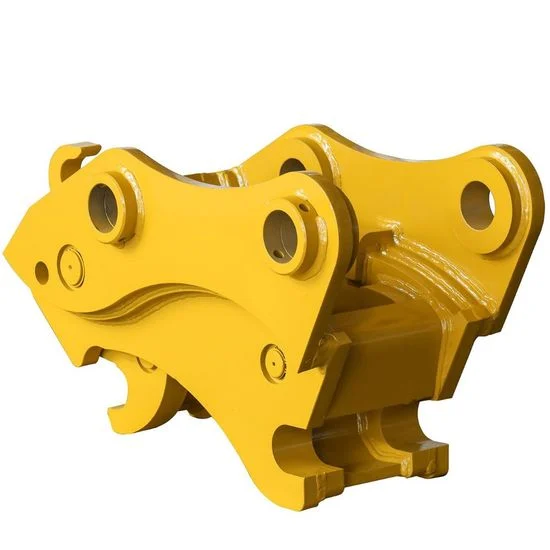
A grapple can be pinned directly to the stick or picked up by a quick coupler. A coupler makes sense where the machine changes between grapple and bucket during the day, for example loading logs in the morning and cleaning the yard in the afternoon.
The coupler adds weight and moves the grapple further from the stick pin, which reduces the net capacity at reach. The JXK-06 hydraulic quick coupler weighs 220–250 kg and fits 380–420 mm pin centres with a 232–315 mm arm width; add that mass to the log and grapple when reading the lift chart. Hydraulic couplers also need their own control circuit, and every pickup must be checked for lock engagement before lifting, following the coupler manufacturer’s procedure.
Timber-yard layout and stacking
- Sort by length and grade at the unloading point so stacks hold uniform logs and are stable.
- Keep stacks to a height the machine can reach without stretching, and leave space between stacks for access and fire separation.
- Work on firm, level hardstanding. Soft ground under a loaded excavator at reach reduces stability.
- Plan truck lanes so vehicles can enter, load and leave without reversing past the working machine.
- Clear bark, offcuts and debris regularly; a skid-steer grapple bucket with a 44 inch opening handles loose material between stacks.
Grapple wear points and daily checks
| Area | What to look for | Parts to order |
|---|---|---|
| Jaw pivots | Play in the pins, uneven jaw closing, dry grease points | Pins and bushes by position |
| Jaw cylinders | Oil on the rods, jaws that drift open under load | Cylinder seal kits |
| Rotator | Rotation drift, noise, oil at the motor or swivel | Rotator seals and bearing items |
| Tines | Cracks at welds, bent or worn tips | Repair to the manufacturer’s method |
| Hoses | Chafing at the link, leaks at fittings | Hose assemblies by bore, ends and length |
Grease the pivot points at the interval the grapple manufacturer gives, more often in wet or dusty yards, and inspect the head at the start of each shift.
Log loading and timber handling questions
Should I choose a fixed or rotating log grapple?
A fixed grapple is simpler and needs less flow, and suits work where logs can be picked up in the orientation they will be placed. A rotating grapple turns the load independently, which speeds truck loading and stacking when logs lie at an angle to the target. It needs two hydraulic functions and more flow.
What excavator size do I need for log loading?
Size the machine for the heaviest log or bundle plus the grapple at the longest reach you will use. Grapples on the site run from the 4–6 tonne JT-02 to the 36 tonne JSG-DL36. Check the lift chart, not only the grapple’s carrier class.
How do I estimate the weight of a log?
Multiply π ÷ 4 by the diameter squared and by the length to get the volume in cubic metres, then multiply by the timber’s density. Green wood is often around one tonne per cubic metre, and some species weigh more, so allow a margin.
Can a log grapple be used for lifting other loads?
A grapple is a material-handling tool for logs and similar material. Lifting slung loads with an excavator is a regulated lifting operation in many places and needs a rated lifting point, an approved configuration and the machine’s lifting safety devices. Follow the machine manufacturer’s instructions and local lifting rules.
Do I need two auxiliary circuits for a rotating grapple?
Two circuits give the best control because grip and rotation work at the same time. A single circuit with an electric diverter valve also works and is cheaper to install, but the operator must switch between functions. Either way, check the rotation pressure setting recommended by the grapple manufacturer.