
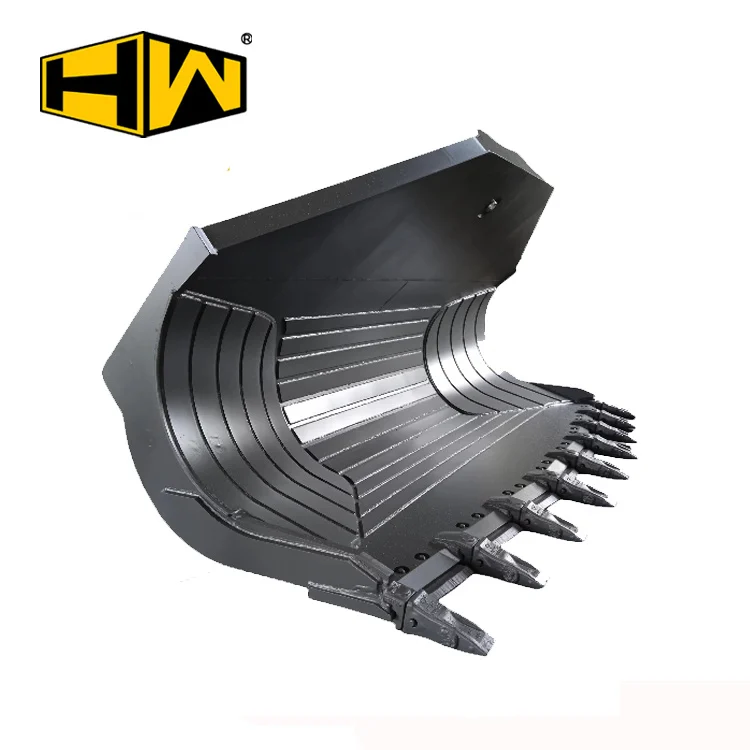
Side Dump Buckets for Skid Steers & Wheel Loaders
HWSD9869 1.5 m³ Wheel-Loader Side Dump Bucket
2600 mm wide, 1890 kg bucket with 45° side-dump specification for the 5 tonne loader class.
1.5 m³ · 2600 mm width
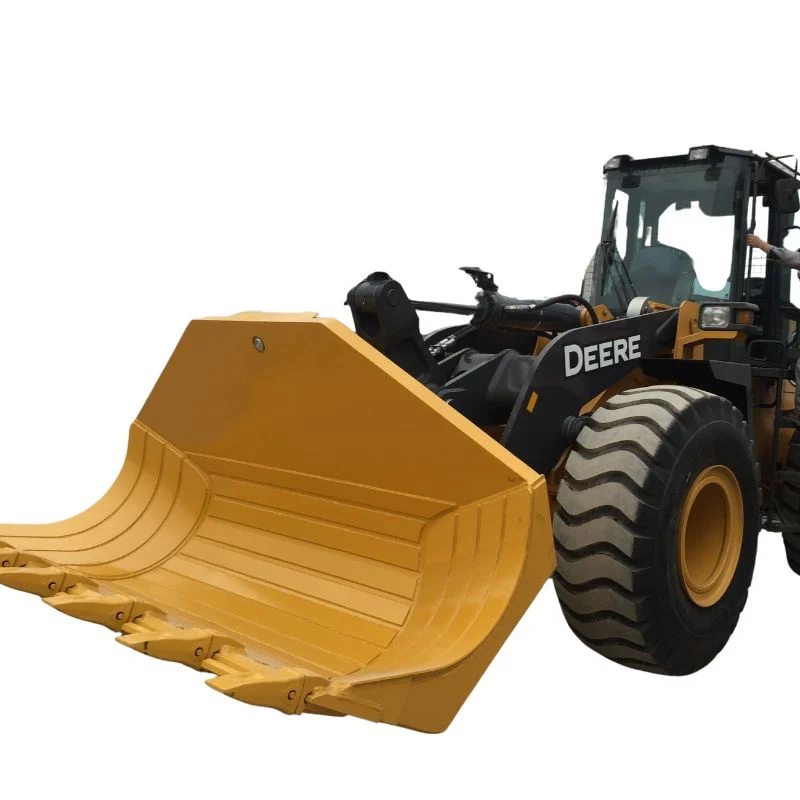
Side Dump Buckets for Skid Steers & Wheel Loaders
HWSD879 is a 1.2 m³ wheel-loader side dump bucket, 2, 380 mm wide and 1, 350 kg empty. The model serves the supplier’s 4 tonne rated-load loader class. Its 45° left/right discharge arrangement places material beside the travel lane for trench backfill, levee work and confined access.
| Model / part number | HWSD879 |
|---|---|
| Bucket capacity | 1.2 m³ |
| Bucket width | 2380 mm |
| Weight | 1350 kg |
| Side dump angle | 45° left / 45° right |
| Material selection | Q355B / NM400 |
| Loader rated-load class | 4 t |
A conventional front dump requires the loader to face the receiving point. Side discharge places material across the travel direction, useful beside a trench or along a narrow lane. The HWSD879 width is 2, 380 mm; draw the lane, receiving edge and lateral discharge envelope together to see how the bucket fits the work.
The model’s 4 tonne loader class describes the loader rated-load category. The empty bucket contributes 1, 350 kg to the working assembly. Material mass is calculated from the 1.2 m³ volume and its bulk density; it is a separate quantity from the loader class.
| Specified bulk density | Material mass | Plus empty bucket |
|---|---|---|
| 1.2 t/m³ | 1.44 t | 2.79 t before mounting items |
| 1.6 t/m³ | 1.92 t | 3.27 t before mounting items |
| 2.0 t/m³ | 2.40 t | 3.75 t before mounting items |
The machine-side linkage, side-dump cylinder arrangement and hydraulic connections describe the mounted configuration. Q355B / NM400 material selections and bolt-on or welded edges are order choices. A bolt-on edge is replaced with its fasteners; a welded edge is a different repair job. Keep the edge type in the initial bucket order.
| Field | HWSD879 | HWSD9869 |
|---|---|---|
| Volume | 1.2 m³ | 1.5 m³ |
| Bucket width | 2,380 mm | 2,600 mm |
| Empty mass | 1,350 kg | 1,890 kg |
| Material at 1.6 t/m³ | 1,920 kg | 2,400 kg |
| Bucket plus that material | 3,270 kg | 4,290 kg |
| Loader rated-load class | 4 t | 5 t |
A 4 t rated-load wheel loader normally works with a general-purpose bucket much larger than 1.2 m³. A side dump bucket is sized smaller for two reasons. First, the sub-frame, pivot and side-tip cylinders make the attachment heavy: HWSD879 weighs 1,350 kg empty. Second, tipping sideways shifts the load across the machine, and a loader is far less stable to the side than to the front. A smaller body keeps the loaded assembly and its side-tipped centre of gravity within a comfortable margin.
Before ordering, compare HWSD879 with the bucket it replaces. If the original bucket is lighter, the difference comes off the loader’s payload. Count any quick coupler too. Then confirm the loaded mass for your main material sits within the rated load with room to spare, because side-tipping is the least stable moment of every cycle.
| Item | What to confirm | Why |
|---|---|---|
| Lower and upper linkage pins | Diameter, centres and ear spacing, or the coupler model | The sub-frame must hang on the loader without shims or adapters |
| Third valve | A spare double-acting section with lines to the arm ends | The side-tip cylinders need their own supply |
| Couplers or hose ends | Type and size at the arm ends | Hoses arrive ready to connect |
| Hose route | Clearance at full lift, full rollback, full dump and full side-tip | Hoses must not stretch or rub on the linkage |
| Bucket width against tyres | 2,380 mm compared with the outside tyre width | The bucket should cover the wheel track on levelling passes |
| Side-tip direction | 45° left / 45° right listing; confirm the build for your job | The discharge side must match the trench side |
Side-tip speed depends on the flow the third valve supplies. A fast tip throws material past a narrow trench; a controlled tip places it. Where the loader has adjustable third-valve flow, set it so the full 45° movement takes a few seconds, not a snap.
Follow the loader maker’s attachment-change procedure and the bucket manual for pin retention and torque. Keep people clear of the discharge side during every test.
Side discharge is fastest when the loader shuttles along the trench in straight lines. A quick calculation shows how many loads a run will take. The example below assumes a 25% allowance between loose and compacted volume; real soils vary, so use your own figures.
| Step | Figure | Note |
|---|---|---|
| Backfill section | 0.6 m wide × 1.0 m deep | Above the pipe bedding |
| Compacted volume per metre | 0.60 m³ | Section area × 1 m |
| Loose volume per metre | 0.75 m³ | Assumed 25% allowance |
| Trench filled per full load | About 1.6 m | 1.2 m³ ÷ 0.75 m³ per metre |
| Loads for 100 m | About 63 | 75 m³ loose ÷ 1.2 m³ |
| Mass per load at 1.5 t/m³ | 1.8 t plus 1.35 t bucket | 3.15 t on the loader arms |
Place backfill in layers of the thickness the project specification allows, and compact each layer before the next. Tipping a full trench depth at once leaves voids that settle later. Keep the loader tyres back from the trench edge by the distance the site’s excavation plan requires, and never use the bucket to support or push against a trench wall.
The page listing names levee work and confined access as uses for HWSD879. On a levee or embankment crest, the loader can travel the crest and tip material down one face without turning on a narrow top. In yards, between buildings or along a single-lane road, it can place material beside the lane where a forward dump would mean a three-point turn.
A side-tipped bucket releases material in a strip about as long as the bucket is deep from front to back, so each tip fills a short length of trench evenly. Spacing the stops to match that strip avoids heaps and gaps that need hand raking.
The specification lists Q355B and NM400. On side dump buckets the wear-resistant plate is usually placed where material slides out: the floor, the front edge and the edge on the discharge side. Ask for the drawing to confirm placement. A bolt-on edge suits work in abrasive sand and gravel, where edges are replaced often; a welded edge suits buyers who prefer a single repair at longer intervals and have welding support nearby.
On a side dump bucket the side edge on the discharge side also wears, because every tip drags material over it. Check that edge as well as the front edge, and include it in the wear-part order.
| Symptom | Likely cause | Check or action |
|---|---|---|
| Side-tip slow or weak | Low third-valve flow or a coupler not fully engaged | Check coupler seating and the valve setting |
| Body creeps sideways under load | Bypassing cylinder seals or valve leakage | Test the cylinders with the lines isolated |
| Body does not return fully level | Air in a cylinder or debris packed under the body | Cycle to purge air; clean the frame |
| Knock when the body returns | Worn side pivot pins or bushes | Measure pin and bore wear and replace as a set |
| Repeated hose damage | Hoses too long or crossing the linkage | Re-route, clamp and replace with the correct length |
| Uneven discharge stream | Worn or bent side edge | Inspect and replace the edge with its fasteners |
Grease the side pivot and cylinder pins at the interval in the manual. On trench work the bucket may tip hundreds of times a day, so a busy machine may need greasing every shift.
| Job profile | Best fit | Reason |
|---|---|---|
| 4 t loader, trench backfill and narrow lanes | HWSD879 | 1.2 m³ and 2,380 mm suit this rated-load class |
| 5 t loader, longer runs and hopper feeding | HWSD9869 1.5 m³ bucket | More volume per cycle on a larger loader |
| Skid steer on small sites and landscaping | MAXX 5643D1 skid-steer side dump | 0.60 yd³ body on a universal skid-steer plate |
For discharge types and side-dump safety across the range, see the side dump bucket guide.
| Product | Mounting | Capacity | Empty mass |
|---|---|---|---|
| MAXX 5643D1 | Skid-steer plate | 0.60 yd³ / 0.459 m³ | 567 kg |
| HWSD879 | Wheel-loader linkage | 1.2 m³ | 1,350 kg |
| HWSD9869 | Wheel-loader linkage | 1.5 m³ | 1,890 kg |
It describes the supplier’s rated-load class. Loader operating weight is a different specification. Include the 1, 350 kg empty bucket and material load in the working combination.
Multiply 1.2 m³ by the specified bulk density. At 1.6 t/m³, the material is 1.92 t; adding the 1.35 t bucket gives 3.27 t before the mounting items.
The wearing edge can be removed and replaced using its fasteners. A welded edge is replaced through a welding repair. The selected edge type changes both the purchase and maintenance lists.
Show the travel-lane width, receiving edge, overhead space and lateral discharge direction. Those measurements describe whether side dumping solves the access problem.
Side dump buckets are normally sized below the loader’s general-purpose bucket. The frame, pivot and cylinders add mass, and side-tipping moves the load sideways, where a loader has much less stability than forwards. The 1.2 m³ body keeps the loaded assembly and the tipped load within a safer margin on a 4 t rated-load machine.
Work out the backfill volume per metre, add an allowance for the difference between loose and compacted material, and divide by 1.2 m³. For a 0.6 m by 1.0 m section with a 25% allowance, one load fills about 1.6 m, so 100 m takes about 63 loads. Use your own soil figures and layer specification.
The specification lists 45° left and 45° right. Confirm with the quotation whether the supplied build tips to both sides or to one selected side, because that decides the cylinder and pivot arrangement. Tell us which side your trench or receiving point is usually on.
Only as high as needed to clear the receiving edge. Raising the bucket lifts the load’s centre of gravity, and tipping it sideways moves it outward at the same time, which is the least stable combination for a loader. Tip low, with the frame straight and the machine on level ground, and follow the loader and bucket manuals for any limits.
Ask for the hydraulic arrangement with the quote. A load-holding or pilot-operated check valve on the side-tip circuit stops the body from rolling if a hose fails or the valve leaks. Where the loader works close to people or above trenches, it is a sensible part of the specification.
For trench and backfill work, order a replacement front edge and discharge-side edge with their fasteners, a seal kit for each side-tip cylinder identified from the cylinder markings, a set of side pivot pins and bushes, and spare hose assemblies with the correct ends. Those parts cover the wear that a busy side-tip cycle produces.
2600 mm wide, 1890 kg bucket with 45° side-dump specification for the 5 tonne loader class.
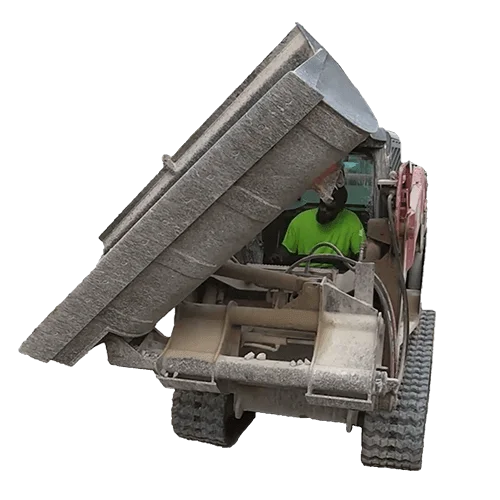
0.60 yd³ / 0.459 m³ skid-steer side-dump bucket; 567 kg; left- or right-discharge build.
Send your machine model, required quantity and destination. Add installation items, wear parts and service quantities to the same inquiry.